Soundpolitics beat me to it on this part of the story (hey, I had to work), but then again I beat them on the original story, so there...
As shown in this post:
The work of the G-8 summit in Gleneagles, Scotland, is the best antidote to the mindless violence of yesterday's murderous assault on London commuters. Uniting to fight poverty and disease pushes back hard against terrorism.
Now of course it comes out that the bombers in London were most likely British citizens, not some third worlders, impoverished or otherwise.
I wonder if the Times will now argue that the best antidote for terrorism is British public school reform?
Wednesday, July 13, 2005
Joe Wilson Lied! Part II
This Rove/Wilson/Plame thing is really heating up. Even if Rove broke the law, which it doesn't appear he did, one thing that is being completely missed by the mainstream media, is the only reason Rove even spoke about "Wilson's wife" is because he was addressing the lies told by Wilson in the first place. I guess the secret to attacking the president is to base it on classified operations. You can lie all you want, and if anyone calls you on it you can claim that they are leaking classified information. Some good references on this are factcheck, Powerline, and the National Review. In light of all of this I decided to take another look at his editorial in the NY Times that started this whole kerfuffle.
What I Didn't Find in Africa
by Joseph C. Wilson 4th
Did the Bush administration manipulate intelligence about Saddam Hussein's weapons programs to justify an invasion of Iraq?
Based on my experience with the administration in the months leading up to the war, I have little choice but to conclude that some of the intelligence related to Iraq's nuclear weapons program was twisted to exaggerate the Iraqi threat.
We have the first bait and switch, he says "exaggerate" which may be a legitimate argument, but that later morphs to basically "make up".
For 23 years, from 1976 to 1998, I was a career foreign service officer and ambassador. In 1990, as chargé d'affaires in Baghdad, I was the last American diplomat to meet with Saddam Hussein. (I was also a forceful advocate for his removal from Kuwait.) After Iraq, I was President George H. W. Bush's ambassador to Gabon and São Tomé and Príncipe; under President Bill Clinton, I helped direct Africa policy for the National Security Council.
It was my experience in Africa that led me to play a small role in the effort to verify information about Africa's suspected link to Iraq's nonconventional weapons programs. Those news stories about that unnamed former envoy who went to Niger? That's me.
Yes, he had experience in Africa, but what led him to this role was the fact that his wife worked for the CIA. The administration didn't seek out this former diplomat, Democrat, anti-war activist, and ardent Kerry supporter for a sensitive collection mission just because he had been to Africa before.
In February 2002, I was informed by officials at the Central Intelligence Agency that Vice President Dick Cheney's office had questions about a particular intelligence report. While I never saw the report, I was told that it referred to a memorandum of agreement that documented the sale of uranium yellowcake — a form of lightly processed ore — by Niger to Iraq in the late 1990's. The agency officials asked if I would travel to Niger to check out the story so they could provide a response to the vice president's office.
Once again, this did not originate at the VPs office, his wife recommended him, this is what Rove was trying to explain.
After consulting with the State Department's African Affairs Bureau (and through it with Barbro Owens-Kirkpatrick, the United States ambassador to Niger), I agreed to make the trip. The mission I undertook was discreet but by no means secret. While the C.I.A. paid my expenses (my time was offered pro bono), I made it abundantly clear to everyone I met that I was acting on behalf of the United States government.
In late February 2002, I arrived in Niger's capital, Niamey, where I had been a diplomat in the mid-70's and visited as a National Security Council official in the late 90's. The city was much as I remembered it. Seasonal winds had clogged the air with dust and sand. Through the haze, I could see camel caravans crossing the Niger River (over the John F. Kennedy bridge), the setting sun behind them. Most people had wrapped scarves around their faces to protect against the grit, leaving only their eyes visible.
What is this, the Travel channel?
The next morning, I met with Ambassador Owens-Kirkpatrick at the embassy. For reasons that are understandable, the embassy staff has always kept a close eye on Niger's uranium business. I was not surprised, then, when the ambassador told me that she knew about the allegations of uranium sales to Iraq — and that she felt she had already debunked them in her reports to Washington. Nevertheless, she and I agreed that my time would be best spent interviewing people who had been in government when the deal supposedly took place, which was before her arrival.
Another bait and switch, the allegations weren't about "sales" to Iraq, it was about Iraq "attempting" to purchase the uranium, two completely different things.
I spent the next eight days drinking sweet mint tea and meeting with dozens of people: current government officials, former government officials, people associated with the country's uranium business. It did not take long to conclude that it was highly doubtful that any such transaction had ever taken place.
He drank tea! Gee, what an thorough indepth investigation. Too bad he couldn't find bin Laden while he was at it. And think about it if any (highly illegal) transactions had taken place, would those officials confess to it, over tea? And once again, the allegation wasn't that there was a transaction, but that Iraq attempted to buy the yellowcake.
Given the structure of the consortiums that operated the mines, it would be exceedingly difficult for Niger to transfer uranium to Iraq. Niger's uranium business consists of two mines, Somair and Cominak, which are run by French, Spanish, Japanese, German and Nigerian interests. If the government wanted to remove uranium from a mine, it would have to notify the consortium, which in turn is strictly monitored by the International Atomic Energy Agency. Moreover, because the two mines are closely regulated, quasi-governmental entities, selling uranium would require the approval of the minister of mines, the prime minister and probably the president. In short, there's simply too much oversight over too small an industry for a sale to have transpired.
Arggghhh!!! Nobody ever claimed the transaction "transpired"! Can you say strawman argument?
(As for the actual memorandum, I never saw it. But news accounts have pointed out that the documents had glaring errors — they were signed, for example, by officials who were no longer in government — and were probably forged. And then there's the fact that Niger formally denied the charges.)
Here Wilson pulls some time travel magic, since the memos with the "glaring errors" did not show up until 8 months after he made the trip. Simply put, Wilson is lying.
Before I left Niger, I briefed the ambassador on my findings, which were consistent with her own. I also shared my conclusions with members of her staff. In early March, I arrived in Washington and promptly provided a detailed briefing to the C.I.A. I later shared my conclusions with the State Department African Affairs Bureau. There was nothing secret or earth-shattering in my report, just as there was nothing secret about my trip.
Of course Wilson leaves out the fact that what he told the CIA, according to the bipartisan Iraq Intelligence committee, bolstered their contention that Iraq had attempted to buy uranium! Joe Wilson lied about his own report.
Though I did not file a written report, there should be at least four documents in United States government archives confirming my mission. The documents should include the ambassador's report of my debriefing in Niamey, a separate report written by the embassy staff, a C.I.A. report summing up my trip, and a specific answer from the agency to the office of the vice president (this may have been delivered orally). While I have not seen any of these reports, I have spent enough time in government to know that this is standard operating procedure.
I thought the Niger matter was settled and went back to my life. (I did take part in the Iraq debate, arguing that a strict containment regime backed by the threat of force was preferable to an invasion.) In September 2002, however, Niger re-emerged. The British government published a "white paper" asserting that Saddam Hussein and his unconventional arms posed an immediate danger. As evidence, the report cited Iraq's attempts to purchase uranium from an African country.
And Britain also did an review of this intelligence, known as the Butler Report, and they still stand by it! I guess due to his week of sipping tea Wilson had suddenly become an expert on MI-5 intelligence.
Then, in January, President Bush, citing the British dossier, repeated the charges about Iraqi efforts to buy uranium from Africa.
Yes, and the Brits still stand by this. Is this somehow Bush's fault?
The next day, I reminded a friend at the State Department of my trip and suggested that if the president had been referring to Niger, then his conclusion was not borne out by the facts as I understood them. He replied that perhaps the president was speaking about one of the other three African countries that produce uranium: Gabon, South Africa or Namibia. At the time, I accepted the explanation. I didn't know that in December, a month before the president's address, the State Department had published a fact sheet that mentioned the Niger case.
Those are the facts surrounding my efforts. The vice president's office asked a serious question. I was asked to help formulate the answer. I did so, and I have every confidence that the answer I provided was circulated to the appropriate officials within our government.
So Wilson is the end all and be all of Niger intelligence? What an ego.
The question now is how that answer was or was not used by our political leadership. If my information was deemed inaccurate, I understand (though I would be very interested to know why). If, however, the information was ignored because it did not fit certain preconceptions about Iraq, then a legitimate argument can be made that we went to war under false pretenses. (It's worth remembering that in his March "Meet the Press" appearance, Mr. Cheney said that Saddam Hussein was "trying once again to produce nuclear weapons.") At a minimum, Congress, which authorized the use of military force at the president's behest, should want to know if the assertions about Iraq were warranted.
Or how about a third option, his limited report supported the possibility that Iraq was trying to buy uranium from Niger.
I was convinced before the war that the threat of weapons of mass destruction in the hands of Saddam Hussein required a vigorous and sustained international response to disarm him. Iraq possessed and had used chemical weapons; it had an active biological weapons program and quite possibly a nuclear research program — all of which were in violation of United Nations resolutions. Having encountered Mr. Hussein and his thugs in the run-up to the Persian Gulf war of 1991, I was only too aware of the dangers he posed.
But were these dangers the same ones the administration told us about? We have to find out. America's foreign policy depends on the sanctity of its information. For this reason, questioning the selective use of intelligence to justify the war in Iraq is neither idle sniping nor "revisionist history," as Mr. Bush has suggested. The act of war is the last option of a democracy, taken when there is a grave threat to our national security. More than 200 American soldiers have lost their lives in Iraq already. We have a duty to ensure that their sacrifice came for the right reasons.
Actually a reasonable ending, unfortunately his argument does not support the conclusion.
Joseph C. Wilson 4th, United States ambassador to Gabon from 1992 to 1995, is an international business consultant.
What I Didn't Find in Africa
by Joseph C. Wilson 4th
Did the Bush administration manipulate intelligence about Saddam Hussein's weapons programs to justify an invasion of Iraq?
Based on my experience with the administration in the months leading up to the war, I have little choice but to conclude that some of the intelligence related to Iraq's nuclear weapons program was twisted to exaggerate the Iraqi threat.
We have the first bait and switch, he says "exaggerate" which may be a legitimate argument, but that later morphs to basically "make up".
For 23 years, from 1976 to 1998, I was a career foreign service officer and ambassador. In 1990, as chargé d'affaires in Baghdad, I was the last American diplomat to meet with Saddam Hussein. (I was also a forceful advocate for his removal from Kuwait.) After Iraq, I was President George H. W. Bush's ambassador to Gabon and São Tomé and Príncipe; under President Bill Clinton, I helped direct Africa policy for the National Security Council.
It was my experience in Africa that led me to play a small role in the effort to verify information about Africa's suspected link to Iraq's nonconventional weapons programs. Those news stories about that unnamed former envoy who went to Niger? That's me.
Yes, he had experience in Africa, but what led him to this role was the fact that his wife worked for the CIA. The administration didn't seek out this former diplomat, Democrat, anti-war activist, and ardent Kerry supporter for a sensitive collection mission just because he had been to Africa before.
In February 2002, I was informed by officials at the Central Intelligence Agency that Vice President Dick Cheney's office had questions about a particular intelligence report. While I never saw the report, I was told that it referred to a memorandum of agreement that documented the sale of uranium yellowcake — a form of lightly processed ore — by Niger to Iraq in the late 1990's. The agency officials asked if I would travel to Niger to check out the story so they could provide a response to the vice president's office.
Once again, this did not originate at the VPs office, his wife recommended him, this is what Rove was trying to explain.
After consulting with the State Department's African Affairs Bureau (and through it with Barbro Owens-Kirkpatrick, the United States ambassador to Niger), I agreed to make the trip. The mission I undertook was discreet but by no means secret. While the C.I.A. paid my expenses (my time was offered pro bono), I made it abundantly clear to everyone I met that I was acting on behalf of the United States government.
In late February 2002, I arrived in Niger's capital, Niamey, where I had been a diplomat in the mid-70's and visited as a National Security Council official in the late 90's. The city was much as I remembered it. Seasonal winds had clogged the air with dust and sand. Through the haze, I could see camel caravans crossing the Niger River (over the John F. Kennedy bridge), the setting sun behind them. Most people had wrapped scarves around their faces to protect against the grit, leaving only their eyes visible.
What is this, the Travel channel?
The next morning, I met with Ambassador Owens-Kirkpatrick at the embassy. For reasons that are understandable, the embassy staff has always kept a close eye on Niger's uranium business. I was not surprised, then, when the ambassador told me that she knew about the allegations of uranium sales to Iraq — and that she felt she had already debunked them in her reports to Washington. Nevertheless, she and I agreed that my time would be best spent interviewing people who had been in government when the deal supposedly took place, which was before her arrival.
Another bait and switch, the allegations weren't about "sales" to Iraq, it was about Iraq "attempting" to purchase the uranium, two completely different things.
I spent the next eight days drinking sweet mint tea and meeting with dozens of people: current government officials, former government officials, people associated with the country's uranium business. It did not take long to conclude that it was highly doubtful that any such transaction had ever taken place.
He drank tea! Gee, what an thorough indepth investigation. Too bad he couldn't find bin Laden while he was at it. And think about it if any (highly illegal) transactions had taken place, would those officials confess to it, over tea? And once again, the allegation wasn't that there was a transaction, but that Iraq attempted to buy the yellowcake.
Given the structure of the consortiums that operated the mines, it would be exceedingly difficult for Niger to transfer uranium to Iraq. Niger's uranium business consists of two mines, Somair and Cominak, which are run by French, Spanish, Japanese, German and Nigerian interests. If the government wanted to remove uranium from a mine, it would have to notify the consortium, which in turn is strictly monitored by the International Atomic Energy Agency. Moreover, because the two mines are closely regulated, quasi-governmental entities, selling uranium would require the approval of the minister of mines, the prime minister and probably the president. In short, there's simply too much oversight over too small an industry for a sale to have transpired.
Arggghhh!!! Nobody ever claimed the transaction "transpired"! Can you say strawman argument?
(As for the actual memorandum, I never saw it. But news accounts have pointed out that the documents had glaring errors — they were signed, for example, by officials who were no longer in government — and were probably forged. And then there's the fact that Niger formally denied the charges.)
Here Wilson pulls some time travel magic, since the memos with the "glaring errors" did not show up until 8 months after he made the trip. Simply put, Wilson is lying.
Before I left Niger, I briefed the ambassador on my findings, which were consistent with her own. I also shared my conclusions with members of her staff. In early March, I arrived in Washington and promptly provided a detailed briefing to the C.I.A. I later shared my conclusions with the State Department African Affairs Bureau. There was nothing secret or earth-shattering in my report, just as there was nothing secret about my trip.
Of course Wilson leaves out the fact that what he told the CIA, according to the bipartisan Iraq Intelligence committee, bolstered their contention that Iraq had attempted to buy uranium! Joe Wilson lied about his own report.
Though I did not file a written report, there should be at least four documents in United States government archives confirming my mission. The documents should include the ambassador's report of my debriefing in Niamey, a separate report written by the embassy staff, a C.I.A. report summing up my trip, and a specific answer from the agency to the office of the vice president (this may have been delivered orally). While I have not seen any of these reports, I have spent enough time in government to know that this is standard operating procedure.
I thought the Niger matter was settled and went back to my life. (I did take part in the Iraq debate, arguing that a strict containment regime backed by the threat of force was preferable to an invasion.) In September 2002, however, Niger re-emerged. The British government published a "white paper" asserting that Saddam Hussein and his unconventional arms posed an immediate danger. As evidence, the report cited Iraq's attempts to purchase uranium from an African country.
And Britain also did an review of this intelligence, known as the Butler Report, and they still stand by it! I guess due to his week of sipping tea Wilson had suddenly become an expert on MI-5 intelligence.
Then, in January, President Bush, citing the British dossier, repeated the charges about Iraqi efforts to buy uranium from Africa.
Yes, and the Brits still stand by this. Is this somehow Bush's fault?
The next day, I reminded a friend at the State Department of my trip and suggested that if the president had been referring to Niger, then his conclusion was not borne out by the facts as I understood them. He replied that perhaps the president was speaking about one of the other three African countries that produce uranium: Gabon, South Africa or Namibia. At the time, I accepted the explanation. I didn't know that in December, a month before the president's address, the State Department had published a fact sheet that mentioned the Niger case.
Those are the facts surrounding my efforts. The vice president's office asked a serious question. I was asked to help formulate the answer. I did so, and I have every confidence that the answer I provided was circulated to the appropriate officials within our government.
So Wilson is the end all and be all of Niger intelligence? What an ego.
The question now is how that answer was or was not used by our political leadership. If my information was deemed inaccurate, I understand (though I would be very interested to know why). If, however, the information was ignored because it did not fit certain preconceptions about Iraq, then a legitimate argument can be made that we went to war under false pretenses. (It's worth remembering that in his March "Meet the Press" appearance, Mr. Cheney said that Saddam Hussein was "trying once again to produce nuclear weapons.") At a minimum, Congress, which authorized the use of military force at the president's behest, should want to know if the assertions about Iraq were warranted.
Or how about a third option, his limited report supported the possibility that Iraq was trying to buy uranium from Niger.
I was convinced before the war that the threat of weapons of mass destruction in the hands of Saddam Hussein required a vigorous and sustained international response to disarm him. Iraq possessed and had used chemical weapons; it had an active biological weapons program and quite possibly a nuclear research program — all of which were in violation of United Nations resolutions. Having encountered Mr. Hussein and his thugs in the run-up to the Persian Gulf war of 1991, I was only too aware of the dangers he posed.
But were these dangers the same ones the administration told us about? We have to find out. America's foreign policy depends on the sanctity of its information. For this reason, questioning the selective use of intelligence to justify the war in Iraq is neither idle sniping nor "revisionist history," as Mr. Bush has suggested. The act of war is the last option of a democracy, taken when there is a grave threat to our national security. More than 200 American soldiers have lost their lives in Iraq already. We have a duty to ensure that their sacrifice came for the right reasons.
Actually a reasonable ending, unfortunately his argument does not support the conclusion.
Joseph C. Wilson 4th, United States ambassador to Gabon from 1992 to 1995, is an international business consultant.


Monday, July 11, 2005
Krugmania
Way too much fun stuff to cover today. Don Luskin has a great takedown of Krugman's latest column. Apparently he is over his health kick and back to lying about the Bush taxcuts. Robert Musil has a great idea of who should replace him at the NY Times. We can only hope. I noticed this referenced in a Weekly Standard article. From the good professor on 21 February 2003:
Meanwhile, outraged Iraqi exiles report that there won't be any equivalent of postwar de-Nazification, in which accomplices of the defeated regime were purged from public life. Instead the Bush administration intends to preserve most of the current regime: Saddam Hussein and a few top officials will be replaced with Americans, but the rest will stay. You don't have to be an Iraq expert to realize that many very nasty people will therefore remain in power — more moral clarity! — and that the U.S. will in effect take responsibility for maintaining the rule of the Sunni minority over the Shiite majority.
Of course only a year later when the administration had carried out their "de-Nazification" Krugman criticizes them for doing that very thing!
And this problem was compounded by a chain of blunders: doing nothing to stop the postwar looting, disbanding the Iraqi Army, canceling local elections, appointing an interim council dominated by exiles with no political base and excluding important domestic groups.
I guess you can have it both ways.
Meanwhile, outraged Iraqi exiles report that there won't be any equivalent of postwar de-Nazification, in which accomplices of the defeated regime were purged from public life. Instead the Bush administration intends to preserve most of the current regime: Saddam Hussein and a few top officials will be replaced with Americans, but the rest will stay. You don't have to be an Iraq expert to realize that many very nasty people will therefore remain in power — more moral clarity! — and that the U.S. will in effect take responsibility for maintaining the rule of the Sunni minority over the Shiite majority.
Of course only a year later when the administration had carried out their "de-Nazification" Krugman criticizes them for doing that very thing!
And this problem was compounded by a chain of blunders: doing nothing to stop the postwar looting, disbanding the Iraqi Army, canceling local elections, appointing an interim council dominated by exiles with no political base and excluding important domestic groups.
I guess you can have it both ways.
Sunday, July 10, 2005
Srebrenica: Ten years later

July 11th is the 10th anniversary of the Srebrenica massacre. The worst mass slaughter to take place in Europe since the Second World War. Last year I served with SFOR XV, the last rotation before the mission was handed to the European Union, EUFOR, often mockingly referred to as Euforia by cynical Bosnians. The Europeans were there as peacekeepers during the massacre, specifically Dutch troops at Srebrenica, so needless to say the Muslims were rather suspicious of the whole thing. Fortunately, after 10 years of peacekeeping, the mission was going quite well. Bosnia is still a poor nation, split by ethnic divides and recovering from the destruction of the war, but largely peaceful. I personally spent a lot of time in Srebrenica, so it always posed a special interest for me. Here are a some pictures that I took, along with some relevent comments.

This is the robna kuca, which is roughly a chain of department stores, in Srebrenica. During the seige it was used to hand out humanitarian aid. As you can see, there are a lot of repairs still needing to be done. The international community has helped build new houses and public buildings (including a brand new mosque donated by Malaysia) but there are few jobs, and the population is still only a fraction of its prewar size.
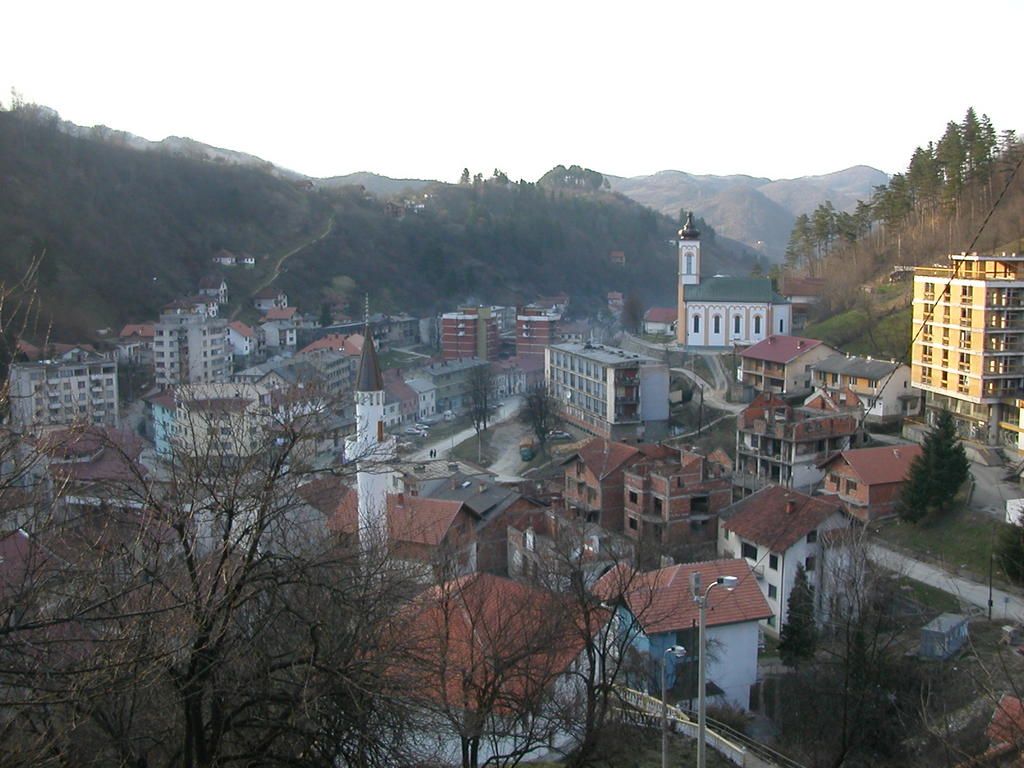
Overlooking the town, including the aforementioned mosque.
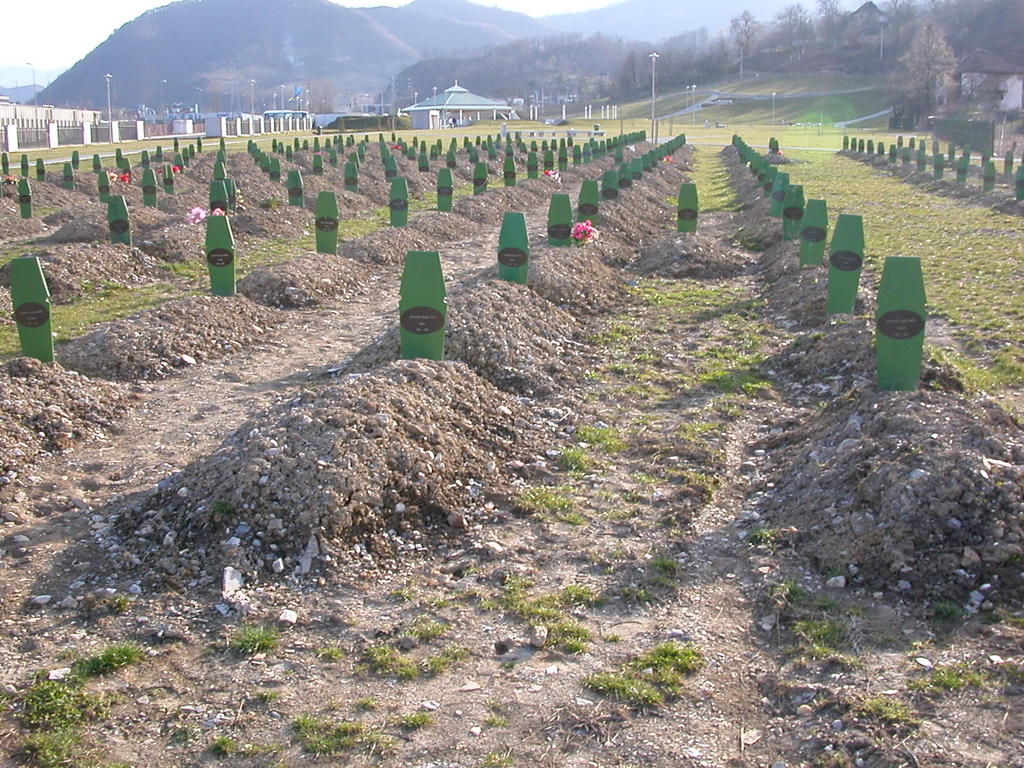
Graves of the victims at the Potocari cemetary. Most of the remains have not yet been identified, therfore only a small number of the 7,000 plus dead have been buried. At the time of this picture a little over 900 if I remember right. The gravesites are grouped, so oftentimes you will see all the male members of one family right together.

A more artistic view of the memorial. The covered area is actually an outdoor mosque. Across the road on the left you can see the battery factory where many of the killings took place.
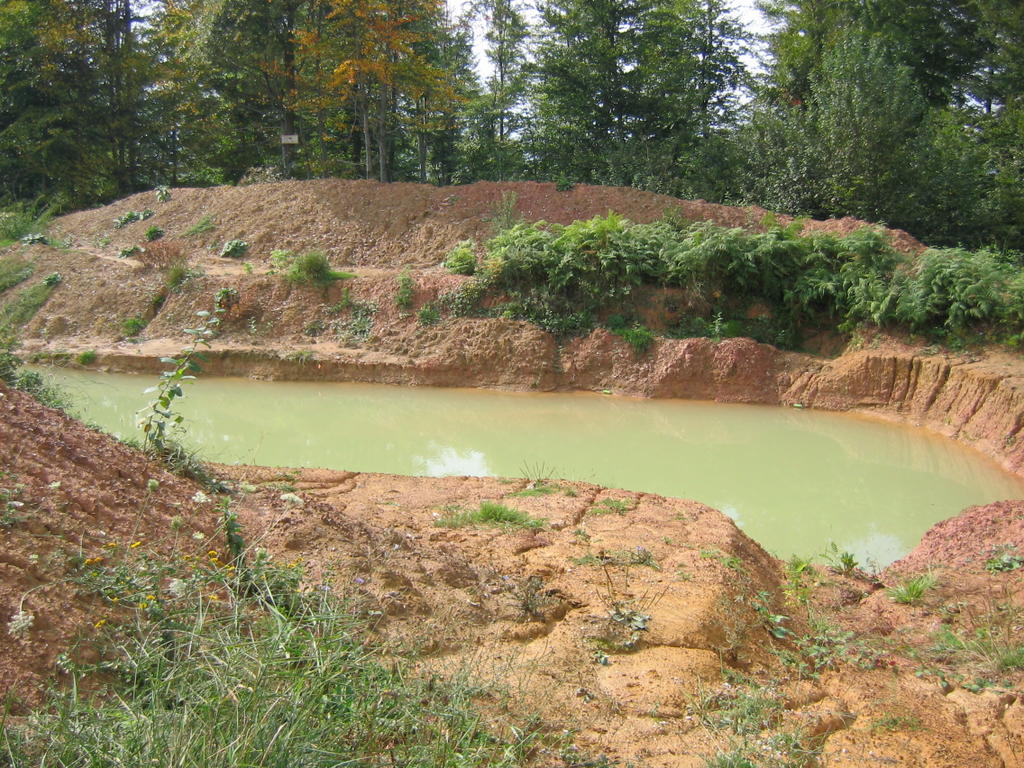
Crni Vrh, a hilltop between Zvornik and Tuzla, site of the largest mass grave found thus far. Over 700 bodies were excavated. To this day it is not uncommon to be driving along and see new sites being worked on.
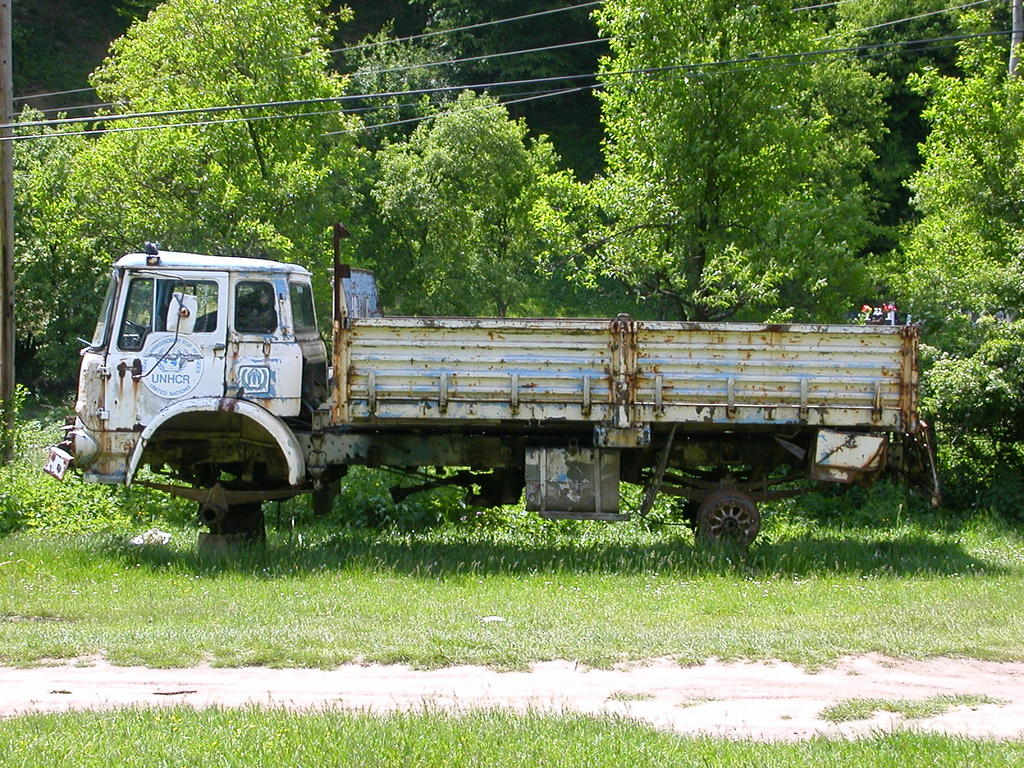
This isn't from Srebrenica, but I always thought it well represented the impotence of the UN,who stood by and watched all this happen.
If you have any questions feel free to leave a comment, and I will try and answer them as best as possible.
Update: Christopher Hitchens has a great editorial on Srebrenica and genocide on Slate in From Srebrenica to Baghdad
Friday, July 08, 2005
The Seattle Times doesn't get it
The Times weighs in with an unsigned editorial today on the London bombings, and in the spirit of Patty "Day Care" Murray, they somehow think the best way to fight terrorists is through aid programs in Africa.
The work of the G-8 summit in Gleneagles, Scotland, is the best antidote to the mindless violence of yesterday's murderous assault on London commuters. Uniting to fight poverty and disease pushes back hard against terrorism.
Now there are a lot of reasons Islamic fascists like Al Qaeda are at war with us, religious, cultural, political, but somehow I don't think it is over debt relief for Africa! Remember, the 9/11 hijackers were mostly from Saudi Arabia, a rather rich country, and were living in relatively good conditions in the US and Europe. It isn't poverty stricken Ugandans or Haitians who are bombing the US, they just want to move here and get jobs. If we want to change the conditions that precipitate terrorism, we need to attack the roots of the hate and corruption in the Islamic world caused by their political, economic, and cultural backwardness maintained by a web of vicious dictatorships. Democracy and freedom in Iraq, Lebanon and other countries in the region will fight terrorism way more than malaria vaccinations in the Congo (not that this is a bad idea). Now why can't the Seattle Times get behind those causes?
The work of the G-8 summit in Gleneagles, Scotland, is the best antidote to the mindless violence of yesterday's murderous assault on London commuters. Uniting to fight poverty and disease pushes back hard against terrorism.
Now there are a lot of reasons Islamic fascists like Al Qaeda are at war with us, religious, cultural, political, but somehow I don't think it is over debt relief for Africa! Remember, the 9/11 hijackers were mostly from Saudi Arabia, a rather rich country, and were living in relatively good conditions in the US and Europe. It isn't poverty stricken Ugandans or Haitians who are bombing the US, they just want to move here and get jobs. If we want to change the conditions that precipitate terrorism, we need to attack the roots of the hate and corruption in the Islamic world caused by their political, economic, and cultural backwardness maintained by a web of vicious dictatorships. Democracy and freedom in Iraq, Lebanon and other countries in the region will fight terrorism way more than malaria vaccinations in the Congo (not that this is a bad idea). Now why can't the Seattle Times get behind those causes?
Paul Krugman: Personal Trainer
There is a lot going on in the world right now, Iraq, the CAFTA debate, Supreme Court appointments, China Trade issues, the G8 summit, bombings in London etc. So what issue is such a hot topic that it warrants not one, but two Krugman articles this week? Obesity. Apparently the good professor is channeling Richard Simmons or something.
Wednesday, July 06, 2005
Joe Wilson Lied!
Powerline has a great article on the whole Wilson/Plame thing. Once again they show why mainstream journalists could take some lessons from the "cat food eating" bloggers. I can't expound on it any better than they did, just read it.
Live 8 full of noise?
I didn't watch the concert, although I would have if I knew Pink Floyd was playing, but this seems to be a bunch of overemotional handwringing to make a bunch of a American and European liberals feel good about themselves, and bad about the evil capitalist west. Jonah Goldberg has an interesting article on this.
And the spectacle was impressive, so much so that Chris Martin of Coldplay declared it "the greatest thing that's ever been organized probably in the history of the world." (You've heard of the Normandy invasion, the Manhattan Project, the Marshall Plan, various moon landings, the 2,000-year-old Catholic Church? Impromptu flea markets! We've got a major-league telecast here.) Passing over Martin's slight overstatement, no harm will come from conceding that it was a very nice concert for those interested in such things.
But tell me, how exactly was Live8 a monumental demonstration of support for helping Africa?
Don Luskin goes one step further and links to an interview with an African economist, who maintains that this type of foreign aid actually hurts more than it helps.
SPIEGEL: Even in a country like Kenya, people are starving to death each year. Someone has got to help them.
Shikwati: But it has to be the Kenyans themselves who help these people. When there's a drought in a region of Kenya, our corrupt politicians reflexively cry out for more help. This call then reaches the United Nations World Food Program -- which is a massive agency of apparatchiks who are in the absurd situation of, on the one hand, being dedicated to the fight against hunger while, on the other hand, being faced with unemployment were hunger actually eliminated. ..., and before long, several thousands tons of corn are shipped to Africa.... A portion of the corn often goes directly into the hands of unsrupulous [sic] politicians who then pass it on to their own tribe to boost their next election campaign. Another portion of the shipment ends up on the black market where the corn is dumped at extremely low prices. Local farmers may as well put down their hoes right away; no one can compete with the UN's World Food Program. And because the farmers go under in the face of this pressure, Kenya would have no reserves to draw on if there actually were a famine next year. It's a simple but fatal cycle.
You would think after decades of failure of the international aid programs it would somehow sink in that things aren't working right. Sure, some things can be done, but what Africa needs to lift itself out of poverty is political and economic reform, not just food shipments and pop concerts. This same thing happened in Somalia during the armed intervention in the 90s (see the book Somalia on Five dollars a Day for an excellent description of this). When the UN came in and passed out all the food, they did two things, they distrupted the local power structure, which is why Aidid attacked them, and they put the farmers out of business. Famine for the most part, unfortunately, is caused by politicians and generals, not by nature.
And the spectacle was impressive, so much so that Chris Martin of Coldplay declared it "the greatest thing that's ever been organized probably in the history of the world." (You've heard of the Normandy invasion, the Manhattan Project, the Marshall Plan, various moon landings, the 2,000-year-old Catholic Church? Impromptu flea markets! We've got a major-league telecast here.) Passing over Martin's slight overstatement, no harm will come from conceding that it was a very nice concert for those interested in such things.
But tell me, how exactly was Live8 a monumental demonstration of support for helping Africa?
Don Luskin goes one step further and links to an interview with an African economist, who maintains that this type of foreign aid actually hurts more than it helps.
SPIEGEL: Even in a country like Kenya, people are starving to death each year. Someone has got to help them.
Shikwati: But it has to be the Kenyans themselves who help these people. When there's a drought in a region of Kenya, our corrupt politicians reflexively cry out for more help. This call then reaches the United Nations World Food Program -- which is a massive agency of apparatchiks who are in the absurd situation of, on the one hand, being dedicated to the fight against hunger while, on the other hand, being faced with unemployment were hunger actually eliminated. ..., and before long, several thousands tons of corn are shipped to Africa.... A portion of the corn often goes directly into the hands of unsrupulous [sic] politicians who then pass it on to their own tribe to boost their next election campaign. Another portion of the shipment ends up on the black market where the corn is dumped at extremely low prices. Local farmers may as well put down their hoes right away; no one can compete with the UN's World Food Program. And because the farmers go under in the face of this pressure, Kenya would have no reserves to draw on if there actually were a famine next year. It's a simple but fatal cycle.
You would think after decades of failure of the international aid programs it would somehow sink in that things aren't working right. Sure, some things can be done, but what Africa needs to lift itself out of poverty is political and economic reform, not just food shipments and pop concerts. This same thing happened in Somalia during the armed intervention in the 90s (see the book Somalia on Five dollars a Day for an excellent description of this). When the UN came in and passed out all the food, they did two things, they distrupted the local power structure, which is why Aidid attacked them, and they put the farmers out of business. Famine for the most part, unfortunately, is caused by politicians and generals, not by nature.
Yes, and I joined the National Guard to avoid the draft
The son of New York governor Pataki, Teddy was recently commissioned a 2nd Lieutenant in the Marine Corps. Rather than congratulate him, the left wing moonbats, including but certainly not limited to Charlie Rangel, are attacking him because he is asking for a deferment to go to law school. This is somehow portrayed as the rich and powerful pulling strings to get him out of combat, even though (obviously) he is a volunteer in the first place, and the Marines have a program set up to allow officers to go to law school. I suppose based on this logic I should be labelled a draft dodger because when I joined the guard I picked a noncombat MOS. LGF has the full scoop on this pathetic story.
Wal*Mart is the devil
My favorite left wing pseudo-academic columnist for the Seattle Times, Floyd McKay, is back. This time with another denunciation of that paragon of evil, Wal*Mart. Among other things Floyd brings us the stunning revelations (gasp) that established businesses do not like new competition, and labor intensive businesses like to keep their labor costs down (this could change economics as we kn0w it). The most hilarious part though, is the utter cluelessness of his conclusions.
Many of those land-use and zoning rules were established at a time when Oregon led the nation in farsighted environmental planning. With the state reeling from rollbacks in education finance, unemployment and attacks on land-use laws, it is good to be able to add a recommendation to those who wonder how to fight a Wal-Mart in their neighborhood.
In addition to "organize," perhaps I should be adding, "Oregonize."
Yeah, their environmental planning was so "farsighted" that it led to a "state reeling from rollbacks in education finance, unemployment and attacks on land-use laws". Let's keep it up!
Many of those land-use and zoning rules were established at a time when Oregon led the nation in farsighted environmental planning. With the state reeling from rollbacks in education finance, unemployment and attacks on land-use laws, it is good to be able to add a recommendation to those who wonder how to fight a Wal-Mart in their neighborhood.
In addition to "organize," perhaps I should be adding, "Oregonize."
Yeah, their environmental planning was so "farsighted" that it led to a "state reeling from rollbacks in education finance, unemployment and attacks on land-use laws". Let's keep it up!
Monday, July 04, 2005
Economic impact of fat people.
Paul Krugman and Brad DeLong are responsible for bankrupting the US health care system!
Hey, I am not making that claim, Krugman is.
I know, I am a very bad boy....
I suppose I should put up some picture of me looking studly in uniform now...
Hey, I am not making that claim, Krugman is.
I know, I am a very bad boy....
I suppose I should put up some picture of me looking studly in uniform now...
4th of July Econo-roundup
Happy Independence Day everyone. As it is a holiday, I have been trying to avoid any original thinking, but I did catch some interesting economic stories. The Warren Buffett Bankruptcy Watch continues, see the earlier posts here and here. Although US markets are closed for the holiday, the Euro is now down to nearly $1.19.

It looks like all those $1.20 sell orders are kicking in. Robert Musil has an interesting update on the legendary Warren Buffett from a couple of days ago.
Scrivener also has a good post on more bad economics reporting from the New York Times. Apparently we have moved beyond Keynesian or supply side economics, to an economics system based purely on the envy of people who have money. Well except for those politically correct upper west side liberal and Hollywood types, the good rich people

It looks like all those $1.20 sell orders are kicking in. Robert Musil has an interesting update on the legendary Warren Buffett from a couple of days ago.
Scrivener also has a good post on more bad economics reporting from the New York Times. Apparently we have moved beyond Keynesian or supply side economics, to an economics system based purely on the envy of people who have money. Well except for those politically correct upper west side liberal and Hollywood types, the good rich people
Friday, July 01, 2005
The Right to Private Property
Although this has been going on for some time, the Kelo decision has brought the right to private property to the forefront again. This right has been under attack for decades, probably more than any other basic right. The so called defenders of civil liberties are all up in arms over the Patriot Act and other alleged threats to our liberties, but they have largely ignored this, probably because it contrasts with their welfare state vision of economics. The right to private property is not just an ancillary issue, it is the basis of the other rights!
There is no freedom of the press, without the right to own the press.
There is no freedom of religion, without the right to build your church, synagogue, or temple.
There is no right to be secure in your home against illegal search and seizure, unless you have a right to your home.
There is no right to keep and bear arms, unless you have somewhere to keep those arms!
There is no freedom of the press, without the right to own the press.
There is no freedom of religion, without the right to build your church, synagogue, or temple.
There is no right to be secure in your home against illegal search and seizure, unless you have a right to your home.
There is no right to keep and bear arms, unless you have somewhere to keep those arms!
Nancy Pelosi Loses Her Grip On Reality: Part II
After declaring the war in Afghanistan safely over, Nancy Pelosi is now delving into the Kelo decision, apparently violating the alleged separation of church and state in the process by deifying the Supreme Court. Does this mean when they replace Sandra Day O'Conner we have to wait for white smoke from the Capitol Building? Here is the choice quote:
Q Could you talk about this decision? What you think of it?
Ms. Pelosi. It is a decision of the Supreme Court. If Congress wants to change it, it will require legislation of a level of a constitutional amendment. So this is almost as if God has spoken. It's an elementary discussion now. They have made the decision.
Hey, I have an idea for a constitutional amendment. Oh sure, it has been tried before, but maybe if we put it in really BIG BOLD LETTERS they will pay attention to it this time.
Amendment V
No person shall be held to answer for a capital, or otherwise infamous crime, unless on a presentment or indictment of a Grand Jury, except in cases arising in the land or naval forces, or in the Militia, when in actual service in time of War or public danger; nor shall any person be subject for the same offence to be twice put in jeopardy of life or limb; nor shall be compelled in any criminal case to be a witness against himself, nor be deprived of life, liberty, or property, without due process of law; nor shall private property be taken for public use, without just compensation.
Hat tip Michelle Malkin and the National Review
Q Could you talk about this decision? What you think of it?
Ms. Pelosi. It is a decision of the Supreme Court. If Congress wants to change it, it will require legislation of a level of a constitutional amendment. So this is almost as if God has spoken. It's an elementary discussion now. They have made the decision.
Hey, I have an idea for a constitutional amendment. Oh sure, it has been tried before, but maybe if we put it in really BIG BOLD LETTERS they will pay attention to it this time.
Amendment V
No person shall be held to answer for a capital, or otherwise infamous crime, unless on a presentment or indictment of a Grand Jury, except in cases arising in the land or naval forces, or in the Militia, when in actual service in time of War or public danger; nor shall any person be subject for the same offence to be twice put in jeopardy of life or limb; nor shall be compelled in any criminal case to be a witness against himself, nor be deprived of life, liberty, or property, without due process of law; nor shall private property be taken for public use, without just compensation.
Hat tip Michelle Malkin and the National Review
Thursday, June 30, 2005
Happy Birthday Dr. Sowell
Thomas Sowell, the columnist and economics professor is celebrating his 75th birthday today. I'll raise a beer for you tonight! I was going to anyway, now I have an excuse.
Silly Advice Column O' the Day
From Slate's Dear Prudence advice column (yes, I read it, for which I am eternally embarassed).
Dear Prudie,I go to a college that borders a small town. I get my hair cut at a local "mom and pop" barbershop, which not only does an excellent job but makes me feel like I am supporting the community. The alternative is a nearby city mall and chain store. Unfortunately, or fortunately, depending on how you look at it, I've been told by a friend that the barber who cuts my hair is, or was, a member of the KKK, a group that I naturally despise. Apparently, my friend overheard him talking about it to someone else. I trust him, but it is possible that he misheard. I would like to avoid a confrontation with the barber, which would be ugly, no matter what. Should I cease my business relationship?
—Neatly trimmed
All I can say is, it is a good thing it is just his/her barber, and not someone important, like say, a United States Senator.
Dear Prudie,I go to a college that borders a small town. I get my hair cut at a local "mom and pop" barbershop, which not only does an excellent job but makes me feel like I am supporting the community. The alternative is a nearby city mall and chain store. Unfortunately, or fortunately, depending on how you look at it, I've been told by a friend that the barber who cuts my hair is, or was, a member of the KKK, a group that I naturally despise. Apparently, my friend overheard him talking about it to someone else. I trust him, but it is possible that he misheard. I would like to avoid a confrontation with the barber, which would be ugly, no matter what. Should I cease my business relationship?
—Neatly trimmed
All I can say is, it is a good thing it is just his/her barber, and not someone important, like say, a United States Senator.
Semper Fi Midshipman!
An interesting story in the Washington Post on a plebe at the Naval Academy. Not your typical freshman class. Not your typical Freshman.
"Eyes straight ahead, all the time!" the upperclassman barked.
Were it not for the silver-dollar-size scar on the inside of his elbow, the legacy of an AK-47 round, Jeffery Walker would look like any other freshman trying to survive the wrenching induction into the U.S. Naval Academy.
The wiry 20-year-old from Conover, N.C., calmly complied, following the yellow line taped to the floor of Alumni Hall on Tuesday. It marked the path to his new uniforms, to doctors' needles, to instructions on a proper salute and, ultimately, to becoming an officer.
Walker knows that no matter how exacting the next four years may be, no one will be shooting at him. Nor will he watch his fellow Marines spill blood on the streets of Fallujah.
"It won't be Iraq," he said.
Walker is part of a small but growing demographic of incoming cadets and midshipmen at the nation's service academies: combat veterans. He has the scar and the Purple Heart to prove it.
"Eyes straight ahead, all the time!" the upperclassman barked.
Were it not for the silver-dollar-size scar on the inside of his elbow, the legacy of an AK-47 round, Jeffery Walker would look like any other freshman trying to survive the wrenching induction into the U.S. Naval Academy.
The wiry 20-year-old from Conover, N.C., calmly complied, following the yellow line taped to the floor of Alumni Hall on Tuesday. It marked the path to his new uniforms, to doctors' needles, to instructions on a proper salute and, ultimately, to becoming an officer.
Walker knows that no matter how exacting the next four years may be, no one will be shooting at him. Nor will he watch his fellow Marines spill blood on the streets of Fallujah.
"It won't be Iraq," he said.
Walker is part of a small but growing demographic of incoming cadets and midshipmen at the nation's service academies: combat veterans. He has the scar and the Purple Heart to prove it.
Ward Watch
Ward Churchill is defending himself in the Denver Post against a recent speech he made in which he suggested fragging officers (something I take a bit personally). His defense is that he was not advocating such an act, merely "sparking discussion" Hat tip Michelle Malkin.
Controversial University of Colorado professor Ward Churchill says he does not advocate "fragging" U.S. military officers in spite of how recent comments he made have been portrayed.
Churchill, speaking at an anti- military forum in Portland, Ore., military remarks
"Conscientious objection removes a given piece of the cannon fodder from the fray," he said. "Fragging an officer has a much more impactful effect."
His remarks were posted Sunday on the Pirate Ballerina blog site, which carries mostly anti- Churchill content. On Wednesday, Fox News' Bill O'Reilly played a tape of the remarks.
Reached at his home in Boulder County on Wednesday night, Churchill said the comments were made merely to spark discussion and not to take a position on fragging, which is the killing or injuring of an officer in combat by a subordinate.
He said that his remarks were being taken out of context and sensationalized in an effort to drive him from his job as a CU professor.
"I neither advocated nor suggested to anyone, anything," Churchill said. "I asked them to think about where they stood on things."
While it may be true that he posed this sentence in the form of a question, is that really a defense? Remember, Larry Summers caused quite a stir, one could even say an uproar, for asking the question, of whether men and women have differences in their congnitive abilities. He didn't advocate that position, he merely asked the question. A better question is, why does Ward even think this is an issue that needs to be raised for discussion?
Controversial University of Colorado professor Ward Churchill says he does not advocate "fragging" U.S. military officers in spite of how recent comments he made have been portrayed.
Churchill, speaking at an anti- military forum in Portland, Ore., military remarks
"Conscientious objection removes a given piece of the cannon fodder from the fray," he said. "Fragging an officer has a much more impactful effect."
His remarks were posted Sunday on the Pirate Ballerina blog site, which carries mostly anti- Churchill content. On Wednesday, Fox News' Bill O'Reilly played a tape of the remarks.
Reached at his home in Boulder County on Wednesday night, Churchill said the comments were made merely to spark discussion and not to take a position on fragging, which is the killing or injuring of an officer in combat by a subordinate.
He said that his remarks were being taken out of context and sensationalized in an effort to drive him from his job as a CU professor.
"I neither advocated nor suggested to anyone, anything," Churchill said. "I asked them to think about where they stood on things."
While it may be true that he posed this sentence in the form of a question, is that really a defense? Remember, Larry Summers caused quite a stir, one could even say an uproar, for asking the question, of whether men and women have differences in their congnitive abilities. He didn't advocate that position, he merely asked the question. A better question is, why does Ward even think this is an issue that needs to be raised for discussion?
Wednesday, June 29, 2005
Back to the Krugman Bashing
After saying relatively nice things about him yesterday I must equal out the whole yin-yang thing. Marginal Revolution has a great post on the distinguished professor and his desertion of the principles of liberalism. It even includes more Adam Smith references. Although I can't believe I am linking to a post which praises Brad DeLong...
Supreme Court Karma
I can only avoid discussing the Kelo decision for so long. In my opinion (and apparently I am not the only one) it is probably the worst decision since Dred Scott. So it made this story rather amusing. I am not sure if anything will become of it, but we can always dream.
Weare, New Hampshire (PRWEB) Could a hotel be built on the land owned by Supreme Court Justice David H. Souter? A new ruling by the Supreme Court which was supported by Justice Souter himself itself might allow it. A private developer is seeking to use this very law to build a hotel on Souter's land.
Justice Souter's vote in the "Kelo vs. City of New London" decision allows city governments to take land from one private owner and give it to another if the government will generate greater tax revenue or other economic benefits when the land is developed by the new owner.
Weare, New Hampshire (PRWEB) Could a hotel be built on the land owned by Supreme Court Justice David H. Souter? A new ruling by the Supreme Court which was supported by Justice Souter himself itself might allow it. A private developer is seeking to use this very law to build a hotel on Souter's land.
Justice Souter's vote in the "Kelo vs. City of New London" decision allows city governments to take land from one private owner and give it to another if the government will generate greater tax revenue or other economic benefits when the land is developed by the new owner.
Subscribe to:
Posts (Atom)