All we hear about is how the US economy is doomed and our companies can't compete, so I was interested in reading this (subscription required) in the Financial Times yesterday (although that pink paper still freaks me out).
In short the FT, a London based paper by the way, conducted an international survey of the most respected companies in the world. US companies took 24 out of the 50 spots, including 12 of the top 14. No other country had more than 6.
Meanwhile news reaches us of Boeing's recent success. China announced the order of $9 billion of their jets.
To plagiarize Mark Twain, the news of our death has been greatly exaggerated.
Saturday, November 19, 2005
Thursday, November 17, 2005
Excess Profit?
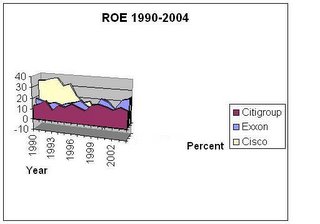
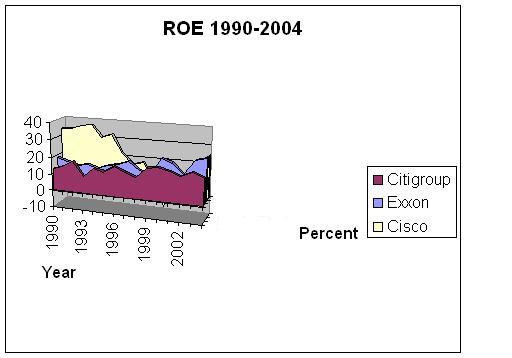
The National Review has a good article on this silly notion of windfall "excess" profit called "Who Profits at the Pump". I was curious so I decided to compare the profit of one of the evil oil companies, in this case Exxon, with two other prominent large companies. If I don't learn anything else, at least getting my MBA is making me a wiz at Excel.


Wednesday, November 16, 2005
The Fake Engineer Shortage
I have found this ridiculous for years. I don't know how many job postings I have seen with ridiculous requirements, such as 5 years of .NET programming experience, 2 years after .NET was released, but yet companies still insist that there is a severe shortage of trained engineers. Mostly this is because they don't know how to hire people, they use laundry lists of requirements in place of good HR practices in screening employees. The last contract I worked on needed someone who could program in C#, which I had never really done, it wasn't even on my resume. They realized I knew what I was doing though, and within a week I had figured out enough to get the job done.
Many companies say they're facing an increasingly severe shortage of engineers. It's so bad, some executives say, that Congress must act to boost funding for engineering education.
Yet unemployed engineers say there's actually a big surplus. "No one I know who has looked at the data with an open mind has been able to find any sign of a current shortage," says demographer Michael Teitelbaum of the Alfred P. Sloan Foundation.
What's really going on? Consider the case of recruiter Rich Carver. In February, he got a call from the U.S. unit of JSP Corp., a Tokyo plastic-foam maker. The company was looking for an engineer with manufacturing experience to serve as a shift supervisor at its Butler, Pa., plant, which makes automobile-bumper parts.
Within two weeks, Mr. Carver and a colleague at the Hudson Highland Group had collected more than 200 résumés. They immediately eliminated just over 100 people who didn't have the required bachelor of science degree, even though many had the kind of job experience the company wanted. A further 65 or so then fell out of the running. Some were deemed overqualified. Others lacked experience with the proper manufacturing software. JSP brought in a half-dozen candidates for an interview, and by August the company had its woman.
To JSP, taking six months to fill the position confirmed its sense that competition for top engineers is intense. Company officials "struggle to fill" openings, says human-resources manager Vicki Senko.
But for candidates facing 200-to-1 odds of getting the job, the struggle seems all on their side. "Companies are looking for a five-pound butterfly. Not finding them doesn't mean there's a shortage of butterflies," says Richard Tax, president of the American Engineering Association, which campaigns to prevent losses of engineering jobs.
Many companies say they're facing an increasingly severe shortage of engineers. It's so bad, some executives say, that Congress must act to boost funding for engineering education.
Yet unemployed engineers say there's actually a big surplus. "No one I know who has looked at the data with an open mind has been able to find any sign of a current shortage," says demographer Michael Teitelbaum of the Alfred P. Sloan Foundation.
What's really going on? Consider the case of recruiter Rich Carver. In February, he got a call from the U.S. unit of JSP Corp., a Tokyo plastic-foam maker. The company was looking for an engineer with manufacturing experience to serve as a shift supervisor at its Butler, Pa., plant, which makes automobile-bumper parts.
Within two weeks, Mr. Carver and a colleague at the Hudson Highland Group had collected more than 200 résumés. They immediately eliminated just over 100 people who didn't have the required bachelor of science degree, even though many had the kind of job experience the company wanted. A further 65 or so then fell out of the running. Some were deemed overqualified. Others lacked experience with the proper manufacturing software. JSP brought in a half-dozen candidates for an interview, and by August the company had its woman.
To JSP, taking six months to fill the position confirmed its sense that competition for top engineers is intense. Company officials "struggle to fill" openings, says human-resources manager Vicki Senko.
But for candidates facing 200-to-1 odds of getting the job, the struggle seems all on their side. "Companies are looking for a five-pound butterfly. Not finding them doesn't mean there's a shortage of butterflies," says Richard Tax, president of the American Engineering Association, which campaigns to prevent losses of engineering jobs.
Tuesday, November 15, 2005
The Iraqi Cindy Sheehan
Maybe she will go on tour with Cindy, and Maureen Dowd can write fawning editorials on her "absolute moral authority."
AMMAN, Jordan (AP) -- The Iraqi woman who said she failed in her bid to blow herself up in an Amman hotel had three brothers killed by U.S. forces, friends of the woman said Tuesday. In a response to the bombings, Jordanian officials unveiled tough new anti-terror measures.
The killings of Sajida Mubarak al-Rishawi's three brothers in Iraq's volatile Anbar province is being considered as a possible motivation behind her bid to take part in last week's triple bombings, which killed 60 people, including her husband and two Iraqi bombers.
AMMAN, Jordan (AP) -- The Iraqi woman who said she failed in her bid to blow herself up in an Amman hotel had three brothers killed by U.S. forces, friends of the woman said Tuesday. In a response to the bombings, Jordanian officials unveiled tough new anti-terror measures.
The killings of Sajida Mubarak al-Rishawi's three brothers in Iraq's volatile Anbar province is being considered as a possible motivation behind her bid to take part in last week's triple bombings, which killed 60 people, including her husband and two Iraqi bombers.
The FAO
A must read article in the WSJ on the role of a Foreign Area Officer (FAO) in Iraq, and what it takes to battle an insurgency.
MOSUL, Iraq -- Last summer, two dozen U.S. Army Rangers headed for the Iraq-Syria border to figure out how foreign fighters were slipping through western Iraq's barren deserts.
As they had done in the past, the Rangers took positions around each village and Bedouin encampment. At one village, an officer named David, accompanied by a small security team, strode into the center looking for someone who would talk. Unlike the clean-shaven, camouflage-clad Rangers, David wore a thick goatee and civilian clothes. The Rangers carried long, black M-4 carbine rifles. David walked with a small 9mm pistol strapped to his leg. The Rangers spoke English. He spoke Arabic tinged with a Yemeni accent.
As he recounts the day, David met a woman with facial tattoos that marked her as her husband's property. As they chatted, the pale-skinned, sandy-haired North Carolina native imitated her dry, throaty way of speaking. "You are Bedu, too," she exclaimed with delight, he recalls.
From her and the other Bedouins, the 37-year-old officer learned that most of the cross-border smuggling was carried out by Shamar tribesmen who peddle cigarettes, sheep and gasoline. Radical Islamists were using the same routes to move people, guns and money. Many of the paths were marked with small piles of bleached rocks that were identical to those David had seen a year earlier while serving in Yemen.
MOSUL, Iraq -- Last summer, two dozen U.S. Army Rangers headed for the Iraq-Syria border to figure out how foreign fighters were slipping through western Iraq's barren deserts.
As they had done in the past, the Rangers took positions around each village and Bedouin encampment. At one village, an officer named David, accompanied by a small security team, strode into the center looking for someone who would talk. Unlike the clean-shaven, camouflage-clad Rangers, David wore a thick goatee and civilian clothes. The Rangers carried long, black M-4 carbine rifles. David walked with a small 9mm pistol strapped to his leg. The Rangers spoke English. He spoke Arabic tinged with a Yemeni accent.
As he recounts the day, David met a woman with facial tattoos that marked her as her husband's property. As they chatted, the pale-skinned, sandy-haired North Carolina native imitated her dry, throaty way of speaking. "You are Bedu, too," she exclaimed with delight, he recalls.
From her and the other Bedouins, the 37-year-old officer learned that most of the cross-border smuggling was carried out by Shamar tribesmen who peddle cigarettes, sheep and gasoline. Radical Islamists were using the same routes to move people, guns and money. Many of the paths were marked with small piles of bleached rocks that were identical to those David had seen a year earlier while serving in Yemen.
Monday, November 14, 2005
Close Call O' the Month
I can see how serial liar Mary Mapes could be so shook up, after avoiding near death at the hands of the Vietcong and all...
KURTZ: You write in "Truth and Duty" that Bush didn't keep his promise to the country. He walked away from his duty. How strongly did you feel then, do you feel now, about that in terms of your pursuing this story?
MAPES: I think that's absolutely true. I have to say, when I grew up, if I'd been a little bit older and if I'd been a boy, I came from a social class where I would have had my rear end in Vietnam.
KURTZ: You write in "Truth and Duty" that Bush didn't keep his promise to the country. He walked away from his duty. How strongly did you feel then, do you feel now, about that in terms of your pursuing this story?
MAPES: I think that's absolutely true. I have to say, when I grew up, if I'd been a little bit older and if I'd been a boy, I came from a social class where I would have had my rear end in Vietnam.
Friday, November 11, 2005
11/11
"Never in the field of human conflict was so much owed by so many to so few."
-Winston Churchill-
On this day just remember those whom we owe so much to.
My father, James F. Bennett Sr.
U.S.M.C. 1962-1964, Vietnam
Semper Fi
My grandfather, Fermin Bennett
US Army Air Corp 1942-1945, Europe
You will always be remembered
-Winston Churchill-
On this day just remember those whom we owe so much to.
My father, James F. Bennett Sr.
U.S.M.C. 1962-1964, Vietnam
Semper Fi
My grandfather, Fermin Bennett
US Army Air Corp 1942-1945, Europe
You will always be remembered
Wednesday, November 09, 2005
Stupid Letter to the Editor O' the Day
From the WSJ
As the author of the windfall legislation your editorial commented on, I must point out some misinterpretations. My bill offers a true windfall profits tax, unlike the 1970s excise tax on oil. The difference between these tax structures is critical to understanding the impact of my bill. I do not advocate an excise tax, which increases the price of oil because both cost of production and profit are taxed. The preferred approach is a windfall profit tax, because it is constructed to tax only excess profit, leaving production costs and reasonable profits unaffected.
A true windfall profits tax raises little revenue because it sends a signal to the industry that price gouging will not be rewarded. Therefore prices quickly return to a reasonable level. Any minor revenue raised gets returned back to the consumer via tax credits.
Rep. Dennis J. Kucinich (D., Ohio)
Washington
Please explain to me Mr. Kucinich, where in the constitution exactly does it give Congress the power, not to mention the wisdom, to determine what is "excess profit"? Did Congress pass a five year plan or something while I was wasn't looking?
For a contrast to this bit of congressionally sponsored idiocy, read this post on Cafe Hayek (written by actual economists) on oil prices and taxes.
As the author of the windfall legislation your editorial commented on, I must point out some misinterpretations. My bill offers a true windfall profits tax, unlike the 1970s excise tax on oil. The difference between these tax structures is critical to understanding the impact of my bill. I do not advocate an excise tax, which increases the price of oil because both cost of production and profit are taxed. The preferred approach is a windfall profit tax, because it is constructed to tax only excess profit, leaving production costs and reasonable profits unaffected.
A true windfall profits tax raises little revenue because it sends a signal to the industry that price gouging will not be rewarded. Therefore prices quickly return to a reasonable level. Any minor revenue raised gets returned back to the consumer via tax credits.
Rep. Dennis J. Kucinich (D., Ohio)
Washington
Please explain to me Mr. Kucinich, where in the constitution exactly does it give Congress the power, not to mention the wisdom, to determine what is "excess profit"? Did Congress pass a five year plan or something while I was wasn't looking?
For a contrast to this bit of congressionally sponsored idiocy, read this post on Cafe Hayek (written by actual economists) on oil prices and taxes.
The Gift that Keeps on Giving
First things first: given all the bad-mouthing the French receive, you may be surprised that I describe their society as "productive." Yet according to the Organization for Economic Cooperation and Development, productivity in France - G.D.P. per hour worked - is actually a bit higher than in the United States.
It's true that France's G.D.P. per person is well below that of the United States. But that's because French workers spend more time with their families.
Paul Krugman in French Family Values
France prides itself on its hourly productivity, among the world's highest. But Philippe Manière, director of the think tank Institut Montaigne, says the high productivity rate is achieved only by shutting out of the job market the immigrants who might cause it to fall. "In France, you employ the most productive people and you leave the rest in the street," he says.
Wall Street Journal, 9 November 2005
It's true that France's G.D.P. per person is well below that of the United States. But that's because French workers spend more time with their families.
Paul Krugman in French Family Values
France prides itself on its hourly productivity, among the world's highest. But Philippe Manière, director of the think tank Institut Montaigne, says the high productivity rate is achieved only by shutting out of the job market the immigrants who might cause it to fall. "In France, you employ the most productive people and you leave the rest in the street," he says.
Wall Street Journal, 9 November 2005
Tuesday, November 08, 2005
Fair Trade?
I needed my caffeine fix this morning so I stopped off at an espresso bar and got a mocha, with a large "fair trade coffee" sticker emblazoned on the side. This got me thinking, what the hell is "fair trade"? I assume they mean there is some minimum price they pay for the coffee to ensure the coffee grower gets a higher than average profit and can pay his workers above the going labor rate. Is this really "fair" trade? If I pay $5 a pound for coffee beans, when I could pay some other guy $4 for the same beans, it is not really fair, I am getting ripped off! What is fair about that?
Only in Bosnia
This is why I never played with the kids.
BANJA LUKA, Bosnia (Reuters) - A hand grenade being used instead of a ball in a game of catch exploded early on Saturday killing three youths in this Bosnian town, police and news agencies said.
BANJA LUKA, Bosnia (Reuters) - A hand grenade being used instead of a ball in a game of catch exploded early on Saturday killing three youths in this Bosnian town, police and news agencies said.
Monday, November 07, 2005
Productivity and Employment
Scrivener has some interesting comments on the fact that manufacturing jobs are down globally, not just in the US. This is not due to the fact that we are exporting our jobs (as many on the left complain) to Mars or some other extraterrerestrial competitor, but simply because productivity gains allow us to produce more goods with less labor. Whenever someone laments the loss of "good jobs" in manufacturing, I like to point out the fact that only a little over a century ago 90% of American were employed in agriculture, now it is around 3%. While obviously the people who had to move off of farms into cities were stressed by the change, does this mean that we should have banned the use of tractors and fertilizer in order to save those "good jobs".? Just look at the percentage of population engaged in agriculture. Uganda is at 97%, the US is at just 3%, does that mean that we should lament the loss of all those good farming jobs to Uganda?
Paul Krugman Was Right
Herr Krugman back in July:
First things first: given all the bad-mouthing the French receive, you may be surprised that I describe their society as "productive." Yet according to the Organization for Economic Cooperation and Development, productivity in France - G.D.P. per hour worked - is actually a bit higher than in the United States.
From the Wall Street Journal today:
It may be difficult nowadays to get people in what the French call the Hexagon to work on Friday afternoons, but not to riot, at least not in the "sensitive" quartiers that surround most towns and cities. The productivity of the rioters has been increasing rapidly of late, and France looks like it will be breaking its record for burnt-out cars: 1,295 on Saturday night alone and 750 on Friday night, 500 the night before, and 300 the night before that. This year so far, the tally is 29,000. If the trend of the last few days continues, geometric progression being what it is, it won't be long before the rioters will have to go to Germany or the Low Countries to express their social conscience in a practical way.
First things first: given all the bad-mouthing the French receive, you may be surprised that I describe their society as "productive." Yet according to the Organization for Economic Cooperation and Development, productivity in France - G.D.P. per hour worked - is actually a bit higher than in the United States.
From the Wall Street Journal today:
It may be difficult nowadays to get people in what the French call the Hexagon to work on Friday afternoons, but not to riot, at least not in the "sensitive" quartiers that surround most towns and cities. The productivity of the rioters has been increasing rapidly of late, and France looks like it will be breaking its record for burnt-out cars: 1,295 on Saturday night alone and 750 on Friday night, 500 the night before, and 300 the night before that. This year so far, the tally is 29,000. If the trend of the last few days continues, geometric progression being what it is, it won't be long before the rioters will have to go to Germany or the Low Countries to express their social conscience in a practical way.
Sunday, November 06, 2005
Stolen Valor: The Iraqi Years Part II
Sadly, I predicted this months ago.
For more than a year, former Marine Staff Sgt. Jimmy Massey has been telling anybody who will listen about the atrocities that he and other Marines committed in Iraq.
In scores of newspaper, magazine and broadcast stories, at a Canadian immigration hearing and in numerous speeches across the country, Massey has told how he and other Marines recklessly, sometimes intentionally, killed dozens of innocent Iraqi civilians.
Among his claims:
Marines fired on and killed peaceful Iraqi protesters.Americans shot a 4-year-old Iraqi girl in the head.
A tractor-trailer was filled with the bodies of civilian men, women and children killed by American artillery.
Massey's claims have gained him celebrity. Last month, Massey's book, "Kill, Kill, Kill," was released in France. His allegations have been reported in nationwide publications such as Vanity Fair and USA Today, as well as numerous broadcast reports. Earlier this year, he joined the anti-war bus tour of Cindy Sheehan, and he's spoken at Cornell and Syracuse universities, among others.
News organizations worldwide published or broadcast Massey's claims without any corroboration and in most cases without investigation. Outside of the Marines, almost no one has seriously questioned whether Massey, a 12-year veteran who was honorably discharged, was telling the truth.
He wasn't.
Each of his claims is either demonstrably false or exaggerated - according to his fellow Marines, Massey's own admissions, and the five journalists who were embedded with Massey's unit, including a reporter and photographer from the Post-Dispatch and reporters from The Associated Press and The Wall Street Journal.
H/T Michele Malkin
For more than a year, former Marine Staff Sgt. Jimmy Massey has been telling anybody who will listen about the atrocities that he and other Marines committed in Iraq.
In scores of newspaper, magazine and broadcast stories, at a Canadian immigration hearing and in numerous speeches across the country, Massey has told how he and other Marines recklessly, sometimes intentionally, killed dozens of innocent Iraqi civilians.
Among his claims:
Marines fired on and killed peaceful Iraqi protesters.Americans shot a 4-year-old Iraqi girl in the head.
A tractor-trailer was filled with the bodies of civilian men, women and children killed by American artillery.
Massey's claims have gained him celebrity. Last month, Massey's book, "Kill, Kill, Kill," was released in France. His allegations have been reported in nationwide publications such as Vanity Fair and USA Today, as well as numerous broadcast reports. Earlier this year, he joined the anti-war bus tour of Cindy Sheehan, and he's spoken at Cornell and Syracuse universities, among others.
News organizations worldwide published or broadcast Massey's claims without any corroboration and in most cases without investigation. Outside of the Marines, almost no one has seriously questioned whether Massey, a 12-year veteran who was honorably discharged, was telling the truth.
He wasn't.
Each of his claims is either demonstrably false or exaggerated - according to his fellow Marines, Massey's own admissions, and the five journalists who were embedded with Massey's unit, including a reporter and photographer from the Post-Dispatch and reporters from The Associated Press and The Wall Street Journal.
H/T Michele Malkin
Quagmire Alert: Bomb factory found in Baghdad
Oh wait, that was Paris, my mistake. I must say I am impressed, the French usually don't hold out this long against an attack.
Arsonists burned 1,295 vehicles nationwide overnight Saturday-Sunday — sharply up from 897 the night before, national police spokesman Patrick Hamon said, adding that police made 349 arrests nationwide.
For a second night, a helicopter equipped with spotlights and video cameras to track bands of marauding youths combed Paris suburbs and small teams of police chased rioters speeding from attack to attack in cars and on motorbikes.
"What we notice is that the bands of youths are, little by little, getting more organized," arranging attacks through cell phone text messages and learning how to make gasoline bombs, Hamon said.
Police also found a gasoline bomb-making factory in a derelict building in Evry south of Paris, with more than 100 bottles ready to turned into bombs, another 50 already prepared, as well as fuel stocks and hoods for hiding rioters' faces, senior Justice Ministry official Jean-Marie Huet told The Associated Press. Police arrested six people, all under 18.
The discovery Saturday night, he said, shows that gasoline bombs "are not being improvised by kids in their bathrooms."
Arsonists burned 1,295 vehicles nationwide overnight Saturday-Sunday — sharply up from 897 the night before, national police spokesman Patrick Hamon said, adding that police made 349 arrests nationwide.
For a second night, a helicopter equipped with spotlights and video cameras to track bands of marauding youths combed Paris suburbs and small teams of police chased rioters speeding from attack to attack in cars and on motorbikes.
"What we notice is that the bands of youths are, little by little, getting more organized," arranging attacks through cell phone text messages and learning how to make gasoline bombs, Hamon said.
Police also found a gasoline bomb-making factory in a derelict building in Evry south of Paris, with more than 100 bottles ready to turned into bombs, another 50 already prepared, as well as fuel stocks and hoods for hiding rioters' faces, senior Justice Ministry official Jean-Marie Huet told The Associated Press. Police arrested six people, all under 18.
The discovery Saturday night, he said, shows that gasoline bombs "are not being improvised by kids in their bathrooms."
Friday, November 04, 2005
Don't Tell Paul Krugman
Ahh, the socialist paradise of France.
Car torchings are a daily fact of life in France's tough suburbs, with thousands burned each month, police say.
Police intelligence has recorded nearly 70,000 incidents of urban violence this year, including attacks on police and rescue services, arson, throwing projectiles, clashes between gangs, joy-riding and property destruction, Le Monde reported.
Car torchings are a daily fact of life in France's tough suburbs, with thousands burned each month, police say.
Police intelligence has recorded nearly 70,000 incidents of urban violence this year, including attacks on police and rescue services, arson, throwing projectiles, clashes between gangs, joy-riding and property destruction, Le Monde reported.
Thursday, November 03, 2005
Fortunately their parents don't read the newspaper
From a Seattle-PI article on a recent student walkout/war protest.
Many students said their parents knew they'd skipped school -- and wouldn't disapprove when they found out.
But some students weren't so sure. "I'll be grounded for the rest of my life," said one of the youngest protesters, 13-year-old Jeri Riley, from Hamilton Middle School.
Many students said their parents knew they'd skipped school -- and wouldn't disapprove when they found out.
But some students weren't so sure. "I'll be grounded for the rest of my life," said one of the youngest protesters, 13-year-old Jeri Riley, from Hamilton Middle School.
The Secrecy Trap
Zell Miller adds some brilliant insight to the whole Plame thing.
It's like a spy thriller. Institutional rivalries and political loyalties have fostered an intelligence officer's resentment against the government. Suddenly, an opportunity appears for the agent to undercut the national leadership. A vital question of intelligence forms the core justification for controversial military actions by the current leaders. If this agent can get in the middle of that question, distort that information and make it public, the agent might foster regime change in the upcoming election.
But the rules on agents are clear. They can't purposely distort gathered intelligence, go public with secret information or use their position or information to manipulate domestic elections or matters without risking their job or jail.
But their spouse can!
The agent realizes her spouse can go out on behalf of the spy agency, can distort information, go public with classified information and use all this spy-agency-sponsored material and credentials to try to pull down the current government, and it is all perfectly legal.
Suppose the spouse adds just one more brilliant, well-aimed lie: claim your foremost political opponent put the spouse up to the trip. As your spouse uses your agency's name to mount attacks, your enemy may fall into your trap. Will your enemy suffer your spouse's lies or take the bait and try to clarify his non-role? If he tells the press he didn't hire your spouse, the press will demand to know, "Then who did?"
Instead of you violating secrecy laws, it is your victim who is guilty because he tried to set the record straight. Heads, you win; tails, he loses.
It sounds unbelievable, a fiction, perhaps to be called "To Sting a King." But it is no fiction. This is the story behind Valerie Plame, Joe Wilson and the Bush administration. And it appears that Plame and Wilson will get away with the biggest sting operation ever.
It's like a spy thriller. Institutional rivalries and political loyalties have fostered an intelligence officer's resentment against the government. Suddenly, an opportunity appears for the agent to undercut the national leadership. A vital question of intelligence forms the core justification for controversial military actions by the current leaders. If this agent can get in the middle of that question, distort that information and make it public, the agent might foster regime change in the upcoming election.
But the rules on agents are clear. They can't purposely distort gathered intelligence, go public with secret information or use their position or information to manipulate domestic elections or matters without risking their job or jail.
But their spouse can!
The agent realizes her spouse can go out on behalf of the spy agency, can distort information, go public with classified information and use all this spy-agency-sponsored material and credentials to try to pull down the current government, and it is all perfectly legal.
Suppose the spouse adds just one more brilliant, well-aimed lie: claim your foremost political opponent put the spouse up to the trip. As your spouse uses your agency's name to mount attacks, your enemy may fall into your trap. Will your enemy suffer your spouse's lies or take the bait and try to clarify his non-role? If he tells the press he didn't hire your spouse, the press will demand to know, "Then who did?"
Instead of you violating secrecy laws, it is your victim who is guilty because he tried to set the record straight. Heads, you win; tails, he loses.
It sounds unbelievable, a fiction, perhaps to be called "To Sting a King." But it is no fiction. This is the story behind Valerie Plame, Joe Wilson and the Bush administration. And it appears that Plame and Wilson will get away with the biggest sting operation ever.
Wednesday, November 02, 2005
Why the Wall Street Journal has the best editorial page in the country
The Journal once again shows that it has the best editorial page. No Michael Moore hypocritical ranting or pointless pseudo populist Bill O'Reilly like screeds, just logical, fact based economic and political analysis.
Like bellbottoms and disco, all kinds of bad ideas from the 1970s are coming back with the surge in energy prices. Arguably the worst is a "windfall" profits tax on oil companies.
This not-so-golden oldie got a political boost last week when Exxon announced, almost apologetically, quarterly profits of nearly $10 billion -- the largest of any U.S. company in history. Apparently it's not enough that 35% of that profit will flow into the Treasury via the corporate income tax. Momentum is growing to raise $10 billion a year by slapping an extra 50% tax on all profits earned on oil above $40 a barrel.
The lead sponsors of the "windfall" levy are Representative Dennis Kucinich of Ohio and Senator Byron Dorgan of North Dakota. These two are well known foes of business for whom the phrase "windfall profits" is redundant. More surprising is that GOP leaders Bill Frist and Dennis Hastert are also calling for Congressional hearings on oil profits. Bill O'Reilly, the chief economist for Fox News, has also been drilling for "windfall" cable ratings by blaming Big Oil for making too much money.
They all need a history lesson. Back when Jimmy Carter signed the windfall profits tax during the last oil crisis, the results were the opposite of what the politicians intended. The first adverse result, as recently documented by the Congressional Research Service, was that oil companies reduced their U.S. domestic production by 1.5 million barrels a day, or by almost 6%. Exploration for new supplies slowed because the tax, by design, snatched as much as a third of the profit from these investments.
Like bellbottoms and disco, all kinds of bad ideas from the 1970s are coming back with the surge in energy prices. Arguably the worst is a "windfall" profits tax on oil companies.
This not-so-golden oldie got a political boost last week when Exxon announced, almost apologetically, quarterly profits of nearly $10 billion -- the largest of any U.S. company in history. Apparently it's not enough that 35% of that profit will flow into the Treasury via the corporate income tax. Momentum is growing to raise $10 billion a year by slapping an extra 50% tax on all profits earned on oil above $40 a barrel.
The lead sponsors of the "windfall" levy are Representative Dennis Kucinich of Ohio and Senator Byron Dorgan of North Dakota. These two are well known foes of business for whom the phrase "windfall profits" is redundant. More surprising is that GOP leaders Bill Frist and Dennis Hastert are also calling for Congressional hearings on oil profits. Bill O'Reilly, the chief economist for Fox News, has also been drilling for "windfall" cable ratings by blaming Big Oil for making too much money.
They all need a history lesson. Back when Jimmy Carter signed the windfall profits tax during the last oil crisis, the results were the opposite of what the politicians intended. The first adverse result, as recently documented by the Congressional Research Service, was that oil companies reduced their U.S. domestic production by 1.5 million barrels a day, or by almost 6%. Exploration for new supplies slowed because the tax, by design, snatched as much as a third of the profit from these investments.
Investigate the CIA
Not to beat a dead horse, but this is exactly what I just said.
Two decades later, the CIA, either purposely or with gross negligence, made a series of decisions that led to Ms. Plame becoming a household name.
• First: The CIA sent her husband, former Ambassador Joseph Wilson, to Niger on a sensitive mission regarding WMD. He was to determine whether Iraq had attempted to purchase yellowcake, an essential ingredient for nonconventional weapons. However, it was Ms. Plame, not Mr. Wilson, who was the WMD expert. Moreover, Mr. Wilson had no intelligence background, was never a senior person in Niger when he was in the State Department, and was opposed to the administration's Iraq policy. The assignment was given, according to the Senate Intelligence Committee, at Ms. Plame's suggestion.
• Second: Mr. Wilson was not required to sign a confidentiality agreement, a mandatory act for the rest of us who either carry out any similar CIA assignment or who represent CIA clients.
• Third: When he returned from Niger, Mr. Wilson was not required to write a report, but rather merely to provide an oral briefing. That information was not sent to the White House. If this mission to Niger were so important, wouldn't a competent intelligence agency want a thoughtful written assessment from the "missionary," if for no other reason than to establish a record to refute any subsequent misrepresentation of that assessment? Because it was the vice president who initially inquired about Niger and the yellowcake (although he had nothing to do with Mr. Wilson being sent), it is curious that neither his office nor the president's were privy to the fruits of Mr. Wilson's oral report.
• Fourth: Although Mr. Wilson did not have to write even one word for the agency that sent him on the mission at taxpayer's expense, over a year later he was permitted to tell all about this sensitive assignment in the New York Times. For the rest of us, writing about such an assignment would mean we'd have to bring our proposed op-ed before the CIA's Prepublication Review Board and spend countless hours arguing over every word to be published. Congressional oversight committees should want to know who at the CIA permitted the publication of the article, which, it has been reported, did not jibe with the thrust of Mr. Wilson's oral briefing. For starters, if the piece had been properly vetted at the CIA, someone should have known that the agency never briefed the vice president on the trip, as claimed by Mr. Wilson in his op-ed.
• Fifth: More important than the inaccuracies is the fact that, if the CIA truly, truly, truly had wanted Ms. Plame's identity to be secret, it never would have permitted her spouse to write the op-ed. Did no one at Langley think that her identity could be compromised if her spouse wrote a piece discussing a foreign mission about a volatile political issue that focused on her expertise? The obvious question a sophisticated journalist such as Mr. Novak asked after "Why did the CIA send Wilson?" was "Who is Wilson?" After being told by a still-unnamed administration source that Mr. Wilson's "wife" suggested him for the assignment, Mr. Novak went to Who's Who, which reveals "Valerie Plame" as Mr. Wilson's spouse.
Two decades later, the CIA, either purposely or with gross negligence, made a series of decisions that led to Ms. Plame becoming a household name.
• First: The CIA sent her husband, former Ambassador Joseph Wilson, to Niger on a sensitive mission regarding WMD. He was to determine whether Iraq had attempted to purchase yellowcake, an essential ingredient for nonconventional weapons. However, it was Ms. Plame, not Mr. Wilson, who was the WMD expert. Moreover, Mr. Wilson had no intelligence background, was never a senior person in Niger when he was in the State Department, and was opposed to the administration's Iraq policy. The assignment was given, according to the Senate Intelligence Committee, at Ms. Plame's suggestion.
• Second: Mr. Wilson was not required to sign a confidentiality agreement, a mandatory act for the rest of us who either carry out any similar CIA assignment or who represent CIA clients.
• Third: When he returned from Niger, Mr. Wilson was not required to write a report, but rather merely to provide an oral briefing. That information was not sent to the White House. If this mission to Niger were so important, wouldn't a competent intelligence agency want a thoughtful written assessment from the "missionary," if for no other reason than to establish a record to refute any subsequent misrepresentation of that assessment? Because it was the vice president who initially inquired about Niger and the yellowcake (although he had nothing to do with Mr. Wilson being sent), it is curious that neither his office nor the president's were privy to the fruits of Mr. Wilson's oral report.
• Fourth: Although Mr. Wilson did not have to write even one word for the agency that sent him on the mission at taxpayer's expense, over a year later he was permitted to tell all about this sensitive assignment in the New York Times. For the rest of us, writing about such an assignment would mean we'd have to bring our proposed op-ed before the CIA's Prepublication Review Board and spend countless hours arguing over every word to be published. Congressional oversight committees should want to know who at the CIA permitted the publication of the article, which, it has been reported, did not jibe with the thrust of Mr. Wilson's oral briefing. For starters, if the piece had been properly vetted at the CIA, someone should have known that the agency never briefed the vice president on the trip, as claimed by Mr. Wilson in his op-ed.
• Fifth: More important than the inaccuracies is the fact that, if the CIA truly, truly, truly had wanted Ms. Plame's identity to be secret, it never would have permitted her spouse to write the op-ed. Did no one at Langley think that her identity could be compromised if her spouse wrote a piece discussing a foreign mission about a volatile political issue that focused on her expertise? The obvious question a sophisticated journalist such as Mr. Novak asked after "Why did the CIA send Wilson?" was "Who is Wilson?" After being told by a still-unnamed administration source that Mr. Wilson's "wife" suggested him for the assignment, Mr. Novak went to Who's Who, which reveals "Valerie Plame" as Mr. Wilson's spouse.
Subscribe to:
Posts (Atom)