I have posted on this subject several times, but this is even dumber than I expected.
The last time Congress imposed a form of the windfall tax was the final gloomy days of Jimmy Carter, and the result was: a substantial reduction in domestic oil production (about 5%), thus raising the price of gas at the pump; and a 10% increase in U.S. reliance on foreign oil. A windfall profits tax is the ultimate act of economic masochism because it taxes only domestic production, while imports and foreign oil subsidiaries bear almost none of the cost.
But wait, this time it's worse. The current Senate proposal would actually require oil companies with daily production of 500,000 barrels or more to disregard generally accepted accounting principles, by revaluing their oil inventories. GAAP accounting (and current tax law) allows oil firms to value barrels of oil sold at what it costs to replace that barrel.
The Senate bill would require the companies to revalue their inventories by $18.75 a barrel -- an arbitrary number if there ever was one. In effect, this means that Congress is creating the illusion of higher oil profits, and thus raising the tax liability of oil companies by an estimated $5 billion next year. This would be on top of the 35% tax rate they already pay on their actual profits.
When Andy Fastow tried to create phony profits at Enron, he got 10 years in the slammer. Now Senators want to create phony corporate profits, so they can grab them to spend. Where's Eliot Spitzer when you really need him? What's even more reprehensible about this revenue grab is its retroactive nature. In a sense this is less a tax than it is an ex post facto confiscation of private property.
Wednesday, November 30, 2005
Economists Correctly Predict 7 of the last 3 Recessions
Despite the best wishes of some the US economy keeps on plugging along quite nicely.
The economy grew at a lively 4.3 percent pace in the third quarter, the best showing in more than a year. The performance offered fresh testimony that the country's overall economic health managed to improve despite the destructive force of Gulf Coast hurricanes.
The new snapshot of economic activity, released by the Commerce Department on Wednesday, showed the growth at an even faster pace than the 3.8 percent annual rate first reported for the July-to-September quarter a month ago.
Of course the NY Times keeps hoping.
Gasoline is cheaper than it was before Hurricane Katrina slammed into New Orleans. Consumer confidence jumped last month and new home sales hit a record. The stock market has been rising. Even the nation's beleaguered factories appear to be headed for a happy holiday season.
By most measures, the economy appears to be doing just fine. No, scratch that, it appears to be booming.
But as always with the United States economy, it is not quite that simple.
Cue ominous music...
The economy grew at a lively 4.3 percent pace in the third quarter, the best showing in more than a year. The performance offered fresh testimony that the country's overall economic health managed to improve despite the destructive force of Gulf Coast hurricanes.
The new snapshot of economic activity, released by the Commerce Department on Wednesday, showed the growth at an even faster pace than the 3.8 percent annual rate first reported for the July-to-September quarter a month ago.
Of course the NY Times keeps hoping.
Gasoline is cheaper than it was before Hurricane Katrina slammed into New Orleans. Consumer confidence jumped last month and new home sales hit a record. The stock market has been rising. Even the nation's beleaguered factories appear to be headed for a happy holiday season.
By most measures, the economy appears to be doing just fine. No, scratch that, it appears to be booming.
But as always with the United States economy, it is not quite that simple.
Cue ominous music...


Tuesday, November 29, 2005
The High Benefit of Low Prices
As I have commented before, WalMart has become the limousine left's favorite whipping boy, responsible for all of society's ills (well except for those caused by Halliburton). Cafe Hayek addresses this, commenting on a Washington Post article. One thing the left doesn't quite seem to understand is it isn't the cocktail circuit crowd that benefits from WalMarts low prices, it is the poor people that they claim to want to help. If the government gives poor people 10% more money, that is good in their eyes, but if WalMart allows them to buy goods at 15% lower prices, they are indifferent to the benefits. This isn't about economics, it is about control.
Wal-Mart's critics allege that the retailer is bad for poor Americans. This claim is backward: As Jason Furman of New York University puts it, Wal-Mart is "a progressive success story." Furman advised John "Benedict Arnold" Kerry in the 2004 campaign and has never received any payment from Wal-Mart; he is no corporate apologist. But he points out that Wal-Mart's discounting on food alone boosts the welfare of American shoppers by at least $50 billion a year. The savings are possibly five times that much if you count all of Wal-Mart's products.
These gains are especially important to poor and moderate-income families. The average Wal-Mart customer earns $35,000 a year, compared with $50,000 at Target and $74,000 at Costco. Moreover, Wal-Mart's "every day low prices" make the biggest difference to the poor, since they spend a higher proportion of income on food and other basics. As a force for poverty relief, Wal-Mart's $200 billion-plus assistance to consumers may rival many federal programs. Those programs are better targeted at the needy, but they are dramatically smaller. Food stamps were worth $33 billion in 2005, and the earned-income tax credit was worth $40 billion.
Wal-Mart's critics allege that the retailer is bad for poor Americans. This claim is backward: As Jason Furman of New York University puts it, Wal-Mart is "a progressive success story." Furman advised John "Benedict Arnold" Kerry in the 2004 campaign and has never received any payment from Wal-Mart; he is no corporate apologist. But he points out that Wal-Mart's discounting on food alone boosts the welfare of American shoppers by at least $50 billion a year. The savings are possibly five times that much if you count all of Wal-Mart's products.
These gains are especially important to poor and moderate-income families. The average Wal-Mart customer earns $35,000 a year, compared with $50,000 at Target and $74,000 at Costco. Moreover, Wal-Mart's "every day low prices" make the biggest difference to the poor, since they spend a higher proportion of income on food and other basics. As a force for poverty relief, Wal-Mart's $200 billion-plus assistance to consumers may rival many federal programs. Those programs are better targeted at the needy, but they are dramatically smaller. Food stamps were worth $33 billion in 2005, and the earned-income tax credit was worth $40 billion.
Monday, November 28, 2005
Does Paul Krugman Still Claim to be an Economist?
From his latest bit of dribble.
We like to think of ourselves as rugged individualists, not like those coddled Europeans with their oversized welfare states. But as Jacob Hacker of Yale points out in his book "The Divided Welfare State," if you add in corporate spending on health care and pensions ... we actually have a welfare state that's about as large relative to our economy as those of other advanced countries. ...
[T]hose who don't work for companies with good benefits are, in effect, second-class citizens. Still, the system more or less worked for several decades after World War II. Now, however, deals are being broken ... What went wrong? An important part of the answer is that America's semi-privatized welfare state worked in the first place only because we had a stable corporate order. And that stability - along with any semblance of economic security for many workers - is now gone.
Regular readers ... know what I think we should do: instead of trying to provide economic security through the back door, via tax breaks designed to encourage corporations to provide health care and pensions, we should provide it through the front door, starting with national health insurance. You may disagree. But one thing is clear: Mr. Drucker's age of discontinuity is also an age of anxiety, in which workers can no longer count on loyalty from their employers.
Surely an economist can distinguish between "welfare" provided by productive corporations which are paying benefits to attract employees, and government which forcibly confiscates wealth in order to distribute to others as it see fit? Can't he? I am taking micro right now, and I am pretty sure the professor mentioned it. I am sure they teach this at MIT too...
We like to think of ourselves as rugged individualists, not like those coddled Europeans with their oversized welfare states. But as Jacob Hacker of Yale points out in his book "The Divided Welfare State," if you add in corporate spending on health care and pensions ... we actually have a welfare state that's about as large relative to our economy as those of other advanced countries. ...
[T]hose who don't work for companies with good benefits are, in effect, second-class citizens. Still, the system more or less worked for several decades after World War II. Now, however, deals are being broken ... What went wrong? An important part of the answer is that America's semi-privatized welfare state worked in the first place only because we had a stable corporate order. And that stability - along with any semblance of economic security for many workers - is now gone.
Regular readers ... know what I think we should do: instead of trying to provide economic security through the back door, via tax breaks designed to encourage corporations to provide health care and pensions, we should provide it through the front door, starting with national health insurance. You may disagree. But one thing is clear: Mr. Drucker's age of discontinuity is also an age of anxiety, in which workers can no longer count on loyalty from their employers.
Surely an economist can distinguish between "welfare" provided by productive corporations which are paying benefits to attract employees, and government which forcibly confiscates wealth in order to distribute to others as it see fit? Can't he? I am taking micro right now, and I am pretty sure the professor mentioned it. I am sure they teach this at MIT too...
Another Sign We Are Too Damn Fat
I feel guilty for not going to the gym this morning.
CHICAGO (Reuters) - Fatter rear ends are causing many drug injections to miss their mark, requiring longer needles to reach buttock muscle, researchers said on Monday.
Standard-sized needles failed to reach the buttock muscle in 23 out of 25 women whose rears were examined after what was supposed to be an intramuscular injection of a drug.
Two-thirds of the 50 patients in the study did not receive the full dosage of the drug, which instead lodged in the fat tissue of their buttocks, researchers from The Adelaide and Meath Hospital in Dublin said in a presentation to the annual meeting of the Radiological Society of North America.
CHICAGO (Reuters) - Fatter rear ends are causing many drug injections to miss their mark, requiring longer needles to reach buttock muscle, researchers said on Monday.
Standard-sized needles failed to reach the buttock muscle in 23 out of 25 women whose rears were examined after what was supposed to be an intramuscular injection of a drug.
Two-thirds of the 50 patients in the study did not receive the full dosage of the drug, which instead lodged in the fat tissue of their buttocks, researchers from The Adelaide and Meath Hospital in Dublin said in a presentation to the annual meeting of the Radiological Society of North America.
The Transportation System of the Future
Seattle has been playing around with the idea of expanding their Disneyland-like monorail for years now. The last I heard they spent millions on the idea and then voted to kill the project. Now the original monorail has accomplished the remarkable feat of colliding with itself. I am not kidding, you have to see the photo.
Tuesday, November 22, 2005
Moonbat English Instructor Resigns
Certified moonbat and illiterate community college English instructor decided to resign today, after threatening a student group and calling for US soldiers to shoot their superiors. The only thing I can add to this is, why does Ward Churchill still have a job?
Late today, the Board was informed of Mr. Daly’s decision to resign his Adjunct position at WCCC effective immediately. In its meeting, the Board voted to accept the resignation agreement and instructed the administration to make certain that students in Mr. Daly’s class are offered the highest quality instruction in this interim period.
Late today, the Board was informed of Mr. Daly’s decision to resign his Adjunct position at WCCC effective immediately. In its meeting, the Board voted to accept the resignation agreement and instructed the administration to make certain that students in Mr. Daly’s class are offered the highest quality instruction in this interim period.
Monday, November 21, 2005
Hitler Wasn't Evil, He Just Had a Different "Perspective"
Talk about moral equivilency.
In a speech to political science students at the University of Toronto yesterday, the host of the CNBC current affairs show Hardball had plenty of harsh words for U.S. President George W. Bush, as well as the political climate that has characterized his country for the past few years.
"The period between 9/11 and Iraq was not a good time for America. There wasn't a robust discussion of what we were doing," Matthews said.
"If we stop trying to figure out the other side, we've given up. The person on the other side is not evil -- they just have a different perspective."
In a speech to political science students at the University of Toronto yesterday, the host of the CNBC current affairs show Hardball had plenty of harsh words for U.S. President George W. Bush, as well as the political climate that has characterized his country for the past few years.
"The period between 9/11 and Iraq was not a good time for America. There wasn't a robust discussion of what we were doing," Matthews said.
"If we stop trying to figure out the other side, we've given up. The person on the other side is not evil -- they just have a different perspective."
UW Beats Harvard
OK, we may have lost the Apple Cup, but the Seattle Times this morning announces that a UW student, at the age of 18, became the second youngest ever to win a Rhodes Scholarship.
Meanwhile, via Taranto, I noticed this headline:
Rhodes Scholars Named, None From Harvard
Too bad, better luck next year.
Meanwhile, via Taranto, I noticed this headline:
Rhodes Scholars Named, None From Harvard
Too bad, better luck next year.
Saturday, November 19, 2005
John "Long Gone" Daly
I did a little research on this moonbat, and it appears Warren County Community College is going to take some action regarding him.
Warren County Community College to Hold an Emergency Meeting
The Board of Trustees of Warren County Community College will convene an emergency meeting of the Board, Tuesday, November 22, 2005 at 6:30 PM. This meeting was called by Board Chair Edward Smith.
The Board of Trustees intends to consider the welfare and rights of its students, the college community, and the public in lieu of recent events. The Board will also consider personnel issues.
Also, to follow up my previous post, it appears he is actually called an "adjunct instructor" I guess holding an MA from Cal State Northridge and teaching remedial English doesn't quite qualify for that professor title. But hey, at least he didn't lie about being an Indian. Did you notice how many grammatical and syntactical errors he made in his e-mail? The sad thing is he is he teaches ENGLISH.
Warren County Community College to Hold an Emergency Meeting
The Board of Trustees of Warren County Community College will convene an emergency meeting of the Board, Tuesday, November 22, 2005 at 6:30 PM. This meeting was called by Board Chair Edward Smith.
The Board of Trustees intends to consider the welfare and rights of its students, the college community, and the public in lieu of recent events. The Board will also consider personnel issues.
Also, to follow up my previous post, it appears he is actually called an "adjunct instructor" I guess holding an MA from Cal State Northridge and teaching remedial English doesn't quite qualify for that professor title. But hey, at least he didn't lie about being an Indian. Did you notice how many grammatical and syntactical errors he made in his e-mail? The sad thing is he is he teaches ENGLISH.
Moonbats in Academia and Persistant Ukrainians
A student at a community college in New Jersey arranged to have a retired colonel speak on campus, which earned her this threatening letter from a professor (if that is what they call them at a community college)
Dear Rebecca:
I am asking my students to boycott your event. I am also going to ask others to boycott it. Your literature and signs in the entrance lobby look like fascist propaganda and is extremely offensive. Your main poster "Communism killed 100,000,000" is not only untrue, but ignores the fact that CAPITALISM has killed many more and the evidence for that can be seen in the daily news papers. The U.S. government can fly to dominate the people of Iraq in 12 hours, yet it took them five days to assist the people devastated by huricane Katrina. Racism and profits were key to their priorities. Exxon, by the way, made $9 Billion in profits this last quarter--their highest proft margin ever. Thanks to the students of WCCC and other poor and working class people who are recruited to fight and die for EXXON and other corporations who earning megaprofits from their imperialist plunders. If you want to count the number of deaths based on political systems, you can begin with the more than a million children who have died in Iraq from U.S.-imposed sanctions and war. Or the million African American people who died from lack of access to healthcare in the US over the last 10 years.
I will continue to expose your right-wing, anti-people politics until groups like your won't dare show their face on a college campus. Real freedom will come when soldiers in Iraq turn their guns on their superiors and fight for just causes and for people's needs--such freedom fighters can be counted throughout American history and they certainly will be counted again.
Prof. John Daly
One could spend hours Fisking the lies in this idiotic rant, but this moron is hardly deserving of the effort. On a related note though, protesters are still demanding that the NY Times return Walter Duranty's Pulitzer Prize for covering up the death of 7 million Ukrainians (part of those 100 million people who were not killed by communism). H/T Don Luskin.
Battling chilly temps and uncooperative winds, a Ukrainian group assembled outside New York Times headquarters in Manhattan Friday to protest the 1932 Pulitzer Prize awarded to Times reporter Walter Duranty for his pro-Stalin coverage of Russia.
The Ukrainian famine of 1932-33 (Ukrainians call it the Holodomor) was engineered by Russian dictator Josef Stalin -- and whitewashed from Duranty's reporting for the Times. Duranty, who covered the country for the Times from 1922 to 1941, ignored Stalin's atrocities, including the famine that killed seven to ten million Ukrainians.
Duranty, who is "credited" for coining the phrase (referring to Stalin’s purges) "You can't make an omelet without breaking eggs," said of the famine accusations, which were reported at the time by left-wing journalists like Malcolm Muggeridge: "Any report of a famine in Russia today is an exaggeration or malignant propaganda."
Another choice quote from Duranty: "Stalin is giving the Russian people-the Russian masses, not Westernized landlords, industrialists, bankers, and intellectuals, but Russia's 150,000,000 peasants and workers-what they really want, namely joint effort, communal effort.'"
Dear Rebecca:
I am asking my students to boycott your event. I am also going to ask others to boycott it. Your literature and signs in the entrance lobby look like fascist propaganda and is extremely offensive. Your main poster "Communism killed 100,000,000" is not only untrue, but ignores the fact that CAPITALISM has killed many more and the evidence for that can be seen in the daily news papers. The U.S. government can fly to dominate the people of Iraq in 12 hours, yet it took them five days to assist the people devastated by huricane Katrina. Racism and profits were key to their priorities. Exxon, by the way, made $9 Billion in profits this last quarter--their highest proft margin ever. Thanks to the students of WCCC and other poor and working class people who are recruited to fight and die for EXXON and other corporations who earning megaprofits from their imperialist plunders. If you want to count the number of deaths based on political systems, you can begin with the more than a million children who have died in Iraq from U.S.-imposed sanctions and war. Or the million African American people who died from lack of access to healthcare in the US over the last 10 years.
I will continue to expose your right-wing, anti-people politics until groups like your won't dare show their face on a college campus. Real freedom will come when soldiers in Iraq turn their guns on their superiors and fight for just causes and for people's needs--such freedom fighters can be counted throughout American history and they certainly will be counted again.
Prof. John Daly
One could spend hours Fisking the lies in this idiotic rant, but this moron is hardly deserving of the effort. On a related note though, protesters are still demanding that the NY Times return Walter Duranty's Pulitzer Prize for covering up the death of 7 million Ukrainians (part of those 100 million people who were not killed by communism). H/T Don Luskin.
Battling chilly temps and uncooperative winds, a Ukrainian group assembled outside New York Times headquarters in Manhattan Friday to protest the 1932 Pulitzer Prize awarded to Times reporter Walter Duranty for his pro-Stalin coverage of Russia.
The Ukrainian famine of 1932-33 (Ukrainians call it the Holodomor) was engineered by Russian dictator Josef Stalin -- and whitewashed from Duranty's reporting for the Times. Duranty, who covered the country for the Times from 1922 to 1941, ignored Stalin's atrocities, including the famine that killed seven to ten million Ukrainians.
Duranty, who is "credited" for coining the phrase (referring to Stalin’s purges) "You can't make an omelet without breaking eggs," said of the famine accusations, which were reported at the time by left-wing journalists like Malcolm Muggeridge: "Any report of a famine in Russia today is an exaggeration or malignant propaganda."
Another choice quote from Duranty: "Stalin is giving the Russian people-the Russian masses, not Westernized landlords, industrialists, bankers, and intellectuals, but Russia's 150,000,000 peasants and workers-what they really want, namely joint effort, communal effort.'"
So Much for the end of the US Economy
All we hear about is how the US economy is doomed and our companies can't compete, so I was interested in reading this (subscription required) in the Financial Times yesterday (although that pink paper still freaks me out).
In short the FT, a London based paper by the way, conducted an international survey of the most respected companies in the world. US companies took 24 out of the 50 spots, including 12 of the top 14. No other country had more than 6.
Meanwhile news reaches us of Boeing's recent success. China announced the order of $9 billion of their jets.
To plagiarize Mark Twain, the news of our death has been greatly exaggerated.
In short the FT, a London based paper by the way, conducted an international survey of the most respected companies in the world. US companies took 24 out of the 50 spots, including 12 of the top 14. No other country had more than 6.
Meanwhile news reaches us of Boeing's recent success. China announced the order of $9 billion of their jets.
To plagiarize Mark Twain, the news of our death has been greatly exaggerated.
Thursday, November 17, 2005
Excess Profit?
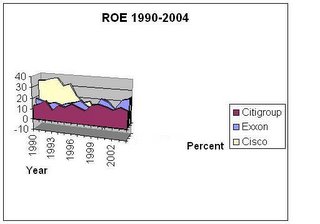
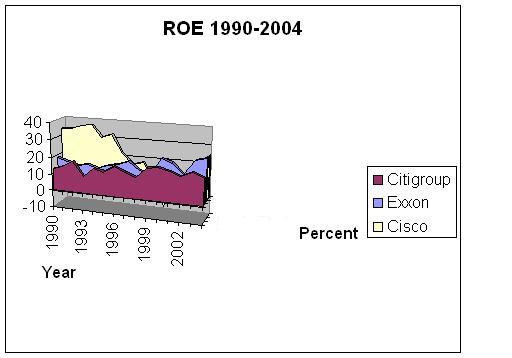
The National Review has a good article on this silly notion of windfall "excess" profit called "Who Profits at the Pump". I was curious so I decided to compare the profit of one of the evil oil companies, in this case Exxon, with two other prominent large companies. If I don't learn anything else, at least getting my MBA is making me a wiz at Excel.
Wednesday, November 16, 2005
The Fake Engineer Shortage
I have found this ridiculous for years. I don't know how many job postings I have seen with ridiculous requirements, such as 5 years of .NET programming experience, 2 years after .NET was released, but yet companies still insist that there is a severe shortage of trained engineers. Mostly this is because they don't know how to hire people, they use laundry lists of requirements in place of good HR practices in screening employees. The last contract I worked on needed someone who could program in C#, which I had never really done, it wasn't even on my resume. They realized I knew what I was doing though, and within a week I had figured out enough to get the job done.
Many companies say they're facing an increasingly severe shortage of engineers. It's so bad, some executives say, that Congress must act to boost funding for engineering education.
Yet unemployed engineers say there's actually a big surplus. "No one I know who has looked at the data with an open mind has been able to find any sign of a current shortage," says demographer Michael Teitelbaum of the Alfred P. Sloan Foundation.
What's really going on? Consider the case of recruiter Rich Carver. In February, he got a call from the U.S. unit of JSP Corp., a Tokyo plastic-foam maker. The company was looking for an engineer with manufacturing experience to serve as a shift supervisor at its Butler, Pa., plant, which makes automobile-bumper parts.
Within two weeks, Mr. Carver and a colleague at the Hudson Highland Group had collected more than 200 résumés. They immediately eliminated just over 100 people who didn't have the required bachelor of science degree, even though many had the kind of job experience the company wanted. A further 65 or so then fell out of the running. Some were deemed overqualified. Others lacked experience with the proper manufacturing software. JSP brought in a half-dozen candidates for an interview, and by August the company had its woman.
To JSP, taking six months to fill the position confirmed its sense that competition for top engineers is intense. Company officials "struggle to fill" openings, says human-resources manager Vicki Senko.
But for candidates facing 200-to-1 odds of getting the job, the struggle seems all on their side. "Companies are looking for a five-pound butterfly. Not finding them doesn't mean there's a shortage of butterflies," says Richard Tax, president of the American Engineering Association, which campaigns to prevent losses of engineering jobs.
Many companies say they're facing an increasingly severe shortage of engineers. It's so bad, some executives say, that Congress must act to boost funding for engineering education.
Yet unemployed engineers say there's actually a big surplus. "No one I know who has looked at the data with an open mind has been able to find any sign of a current shortage," says demographer Michael Teitelbaum of the Alfred P. Sloan Foundation.
What's really going on? Consider the case of recruiter Rich Carver. In February, he got a call from the U.S. unit of JSP Corp., a Tokyo plastic-foam maker. The company was looking for an engineer with manufacturing experience to serve as a shift supervisor at its Butler, Pa., plant, which makes automobile-bumper parts.
Within two weeks, Mr. Carver and a colleague at the Hudson Highland Group had collected more than 200 résumés. They immediately eliminated just over 100 people who didn't have the required bachelor of science degree, even though many had the kind of job experience the company wanted. A further 65 or so then fell out of the running. Some were deemed overqualified. Others lacked experience with the proper manufacturing software. JSP brought in a half-dozen candidates for an interview, and by August the company had its woman.
To JSP, taking six months to fill the position confirmed its sense that competition for top engineers is intense. Company officials "struggle to fill" openings, says human-resources manager Vicki Senko.
But for candidates facing 200-to-1 odds of getting the job, the struggle seems all on their side. "Companies are looking for a five-pound butterfly. Not finding them doesn't mean there's a shortage of butterflies," says Richard Tax, president of the American Engineering Association, which campaigns to prevent losses of engineering jobs.
Tuesday, November 15, 2005
The Iraqi Cindy Sheehan
Maybe she will go on tour with Cindy, and Maureen Dowd can write fawning editorials on her "absolute moral authority."
AMMAN, Jordan (AP) -- The Iraqi woman who said she failed in her bid to blow herself up in an Amman hotel had three brothers killed by U.S. forces, friends of the woman said Tuesday. In a response to the bombings, Jordanian officials unveiled tough new anti-terror measures.
The killings of Sajida Mubarak al-Rishawi's three brothers in Iraq's volatile Anbar province is being considered as a possible motivation behind her bid to take part in last week's triple bombings, which killed 60 people, including her husband and two Iraqi bombers.
AMMAN, Jordan (AP) -- The Iraqi woman who said she failed in her bid to blow herself up in an Amman hotel had three brothers killed by U.S. forces, friends of the woman said Tuesday. In a response to the bombings, Jordanian officials unveiled tough new anti-terror measures.
The killings of Sajida Mubarak al-Rishawi's three brothers in Iraq's volatile Anbar province is being considered as a possible motivation behind her bid to take part in last week's triple bombings, which killed 60 people, including her husband and two Iraqi bombers.
The FAO
A must read article in the WSJ on the role of a Foreign Area Officer (FAO) in Iraq, and what it takes to battle an insurgency.
MOSUL, Iraq -- Last summer, two dozen U.S. Army Rangers headed for the Iraq-Syria border to figure out how foreign fighters were slipping through western Iraq's barren deserts.
As they had done in the past, the Rangers took positions around each village and Bedouin encampment. At one village, an officer named David, accompanied by a small security team, strode into the center looking for someone who would talk. Unlike the clean-shaven, camouflage-clad Rangers, David wore a thick goatee and civilian clothes. The Rangers carried long, black M-4 carbine rifles. David walked with a small 9mm pistol strapped to his leg. The Rangers spoke English. He spoke Arabic tinged with a Yemeni accent.
As he recounts the day, David met a woman with facial tattoos that marked her as her husband's property. As they chatted, the pale-skinned, sandy-haired North Carolina native imitated her dry, throaty way of speaking. "You are Bedu, too," she exclaimed with delight, he recalls.
From her and the other Bedouins, the 37-year-old officer learned that most of the cross-border smuggling was carried out by Shamar tribesmen who peddle cigarettes, sheep and gasoline. Radical Islamists were using the same routes to move people, guns and money. Many of the paths were marked with small piles of bleached rocks that were identical to those David had seen a year earlier while serving in Yemen.
MOSUL, Iraq -- Last summer, two dozen U.S. Army Rangers headed for the Iraq-Syria border to figure out how foreign fighters were slipping through western Iraq's barren deserts.
As they had done in the past, the Rangers took positions around each village and Bedouin encampment. At one village, an officer named David, accompanied by a small security team, strode into the center looking for someone who would talk. Unlike the clean-shaven, camouflage-clad Rangers, David wore a thick goatee and civilian clothes. The Rangers carried long, black M-4 carbine rifles. David walked with a small 9mm pistol strapped to his leg. The Rangers spoke English. He spoke Arabic tinged with a Yemeni accent.
As he recounts the day, David met a woman with facial tattoos that marked her as her husband's property. As they chatted, the pale-skinned, sandy-haired North Carolina native imitated her dry, throaty way of speaking. "You are Bedu, too," she exclaimed with delight, he recalls.
From her and the other Bedouins, the 37-year-old officer learned that most of the cross-border smuggling was carried out by Shamar tribesmen who peddle cigarettes, sheep and gasoline. Radical Islamists were using the same routes to move people, guns and money. Many of the paths were marked with small piles of bleached rocks that were identical to those David had seen a year earlier while serving in Yemen.
Monday, November 14, 2005
Close Call O' the Month
I can see how serial liar Mary Mapes could be so shook up, after avoiding near death at the hands of the Vietcong and all...
KURTZ: You write in "Truth and Duty" that Bush didn't keep his promise to the country. He walked away from his duty. How strongly did you feel then, do you feel now, about that in terms of your pursuing this story?
MAPES: I think that's absolutely true. I have to say, when I grew up, if I'd been a little bit older and if I'd been a boy, I came from a social class where I would have had my rear end in Vietnam.
KURTZ: You write in "Truth and Duty" that Bush didn't keep his promise to the country. He walked away from his duty. How strongly did you feel then, do you feel now, about that in terms of your pursuing this story?
MAPES: I think that's absolutely true. I have to say, when I grew up, if I'd been a little bit older and if I'd been a boy, I came from a social class where I would have had my rear end in Vietnam.
Friday, November 11, 2005
11/11
"Never in the field of human conflict was so much owed by so many to so few."
-Winston Churchill-
On this day just remember those whom we owe so much to.
My father, James F. Bennett Sr.
U.S.M.C. 1962-1964, Vietnam
Semper Fi
My grandfather, Fermin Bennett
US Army Air Corp 1942-1945, Europe
You will always be remembered
-Winston Churchill-
On this day just remember those whom we owe so much to.
My father, James F. Bennett Sr.
U.S.M.C. 1962-1964, Vietnam
Semper Fi
My grandfather, Fermin Bennett
US Army Air Corp 1942-1945, Europe
You will always be remembered
Wednesday, November 09, 2005
Stupid Letter to the Editor O' the Day
From the WSJ
As the author of the windfall legislation your editorial commented on, I must point out some misinterpretations. My bill offers a true windfall profits tax, unlike the 1970s excise tax on oil. The difference between these tax structures is critical to understanding the impact of my bill. I do not advocate an excise tax, which increases the price of oil because both cost of production and profit are taxed. The preferred approach is a windfall profit tax, because it is constructed to tax only excess profit, leaving production costs and reasonable profits unaffected.
A true windfall profits tax raises little revenue because it sends a signal to the industry that price gouging will not be rewarded. Therefore prices quickly return to a reasonable level. Any minor revenue raised gets returned back to the consumer via tax credits.
Rep. Dennis J. Kucinich (D., Ohio)
Washington
Please explain to me Mr. Kucinich, where in the constitution exactly does it give Congress the power, not to mention the wisdom, to determine what is "excess profit"? Did Congress pass a five year plan or something while I was wasn't looking?
For a contrast to this bit of congressionally sponsored idiocy, read this post on Cafe Hayek (written by actual economists) on oil prices and taxes.
As the author of the windfall legislation your editorial commented on, I must point out some misinterpretations. My bill offers a true windfall profits tax, unlike the 1970s excise tax on oil. The difference between these tax structures is critical to understanding the impact of my bill. I do not advocate an excise tax, which increases the price of oil because both cost of production and profit are taxed. The preferred approach is a windfall profit tax, because it is constructed to tax only excess profit, leaving production costs and reasonable profits unaffected.
A true windfall profits tax raises little revenue because it sends a signal to the industry that price gouging will not be rewarded. Therefore prices quickly return to a reasonable level. Any minor revenue raised gets returned back to the consumer via tax credits.
Rep. Dennis J. Kucinich (D., Ohio)
Washington
Please explain to me Mr. Kucinich, where in the constitution exactly does it give Congress the power, not to mention the wisdom, to determine what is "excess profit"? Did Congress pass a five year plan or something while I was wasn't looking?
For a contrast to this bit of congressionally sponsored idiocy, read this post on Cafe Hayek (written by actual economists) on oil prices and taxes.
The Gift that Keeps on Giving
First things first: given all the bad-mouthing the French receive, you may be surprised that I describe their society as "productive." Yet according to the Organization for Economic Cooperation and Development, productivity in France - G.D.P. per hour worked - is actually a bit higher than in the United States.
It's true that France's G.D.P. per person is well below that of the United States. But that's because French workers spend more time with their families.
Paul Krugman in French Family Values
France prides itself on its hourly productivity, among the world's highest. But Philippe Manière, director of the think tank Institut Montaigne, says the high productivity rate is achieved only by shutting out of the job market the immigrants who might cause it to fall. "In France, you employ the most productive people and you leave the rest in the street," he says.
Wall Street Journal, 9 November 2005
It's true that France's G.D.P. per person is well below that of the United States. But that's because French workers spend more time with their families.
Paul Krugman in French Family Values
France prides itself on its hourly productivity, among the world's highest. But Philippe Manière, director of the think tank Institut Montaigne, says the high productivity rate is achieved only by shutting out of the job market the immigrants who might cause it to fall. "In France, you employ the most productive people and you leave the rest in the street," he says.
Wall Street Journal, 9 November 2005
Subscribe to:
Posts (Atom)

